
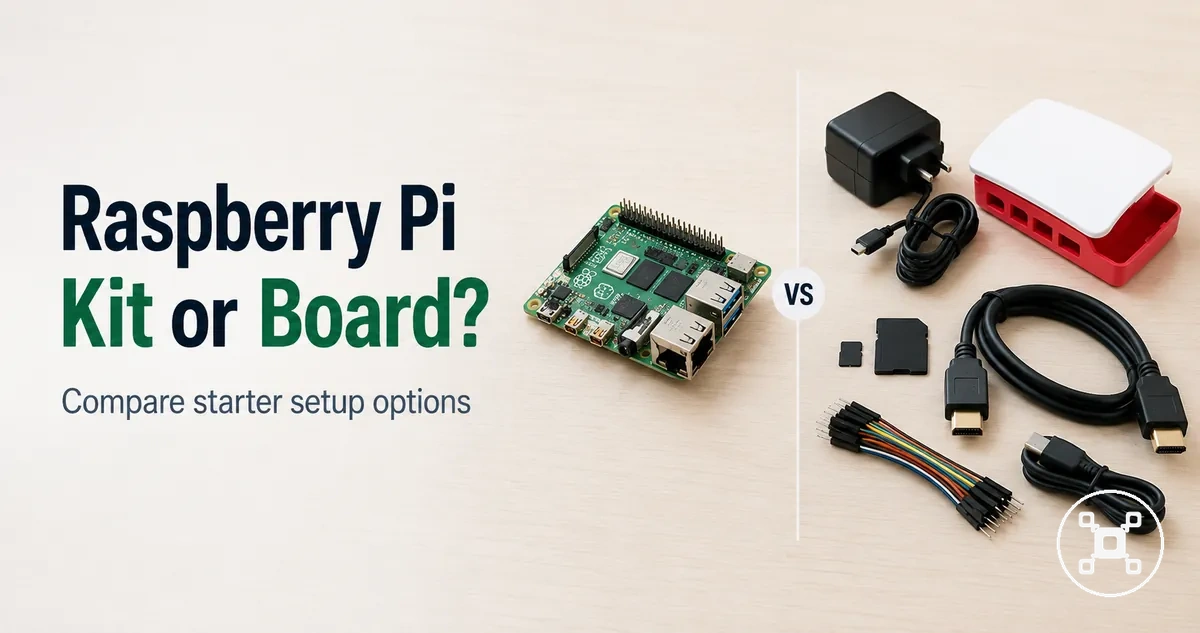
Raspberry Pi kit vs board only for starter setup
A Raspberry Pi starter kit is a practical starting option when a beginner wants fewer setup decisions, while buying the board only gives more control when compatible accessories are already available. A starter kit groups the Raspberry Pi board with selected accessories, while a board-only purchase separates the board choice from accessory selection. The decision depends on setup readiness, compatibility checks, cost, reuse of existing parts, and the intended use case.
A Raspberry Pi kit and board-only buying represent two different starter setup approaches.
A Raspberry Pi kit and board-only buying represent two different starter setup approaches. This comparison sits within the wider Raspberry Pi hub context by focusing on how the two options affect preparation and decision-making. A kit can reduce the number of separate accessory choices for a first setup, while board-only buying can allow more control over selected parts. This page focuses on the starter setup decision rather than full model selection, detailed accessory planning, or installation steps.
These factors define when each approach may better match the user's situation.
For a beginner starting a first Raspberry Pi setup, a starter kit can simplify the initial selection process by reducing separate compatibility checks. For a user who already has suitable accessories, a board-only option can support reuse and more specific part selection. The main comparison factors are setup readiness, accessories, compatibility, cost, reuse, and use case fit. These factors define when each approach may better match the user's situation.
The main comparison factors are setup readiness, accessories, compatibility, cost, reuse, and use case fit.
Raspberry Pi kit vs board only compares readiness, control, cost, and reuse between a bundled setup and a separate board purchase. The comparison below shows how each option changes the parts the user selects and the checks that remain necessary.
| Buying route | What changes | What still needs checking | Decision focus |
|---|---|---|---|
| Raspberry Pi starter kit | The bundle provides a grouped starting option with selected accessories for the setup. | The included accessories still need to match the intended Raspberry Pi use case and required setup conditions. | Setup readiness and fewer separate choices for a beginner. |
| Raspberry Pi board only | The board is selected separately from accessories, allowing existing parts or preferred components to be considered. | Accessory compatibility and suitability remain part of the selection process. | Control and reuse when suitable accessories are already available. |
Table of Contents
What changes when you buy a Raspberry Pi kit instead of the board only
A Raspberry Pi kit changes the buying task from selecting every separate part to evaluating a bundle, while a board-only purchase keeps accessory selection under the buyer's control. A Raspberry Pi kit groups the board with selected accessories, while a board-only purchase separates the Raspberry Pi board from separate parts needed for a setup. The main difference is the balance between bundled readiness and separate-part flexibility.
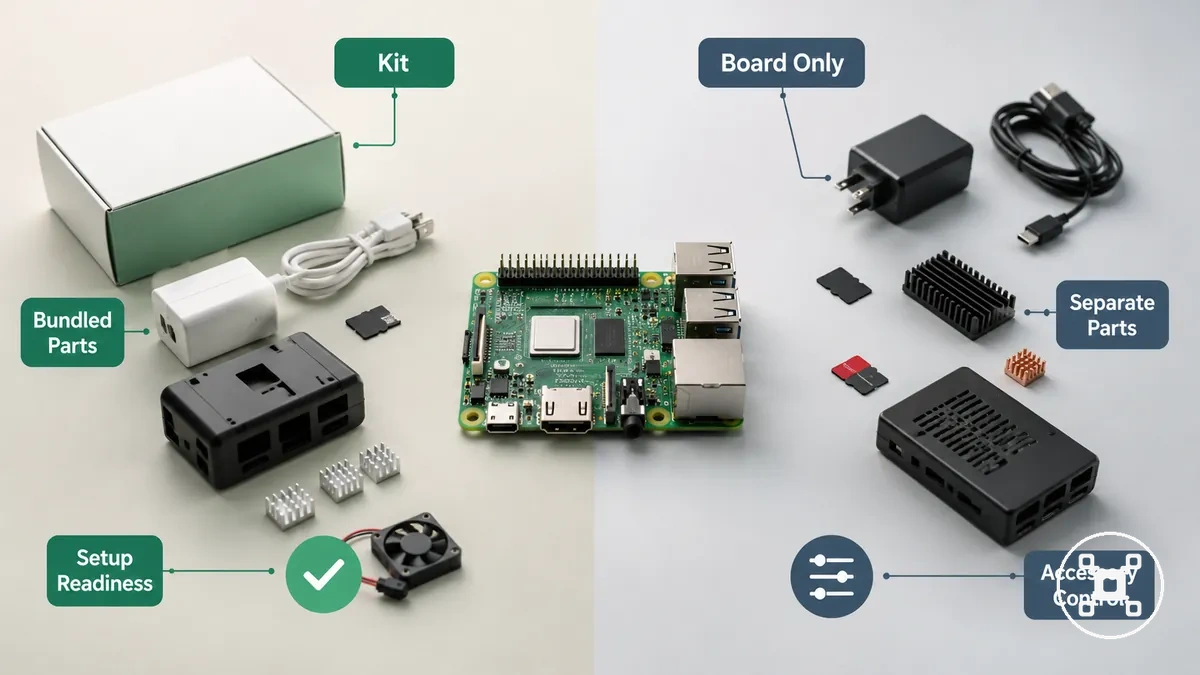
When a Raspberry Pi kit provides bundled parts, the buyer evaluates whether the included accessories match the intended setup instead of selecting every accessory separately. A board-only purchase shifts more responsibility to the buyer because separate accessories must be selected or reused through compatibility checks. This creates a trade-off between reduced selection effort and greater accessory control. A kit does not remove every compatibility check because included parts still need to suit the Raspberry Pi use case and board requirements.
This creates a trade-off between reduced selection effort and greater accessory control.
For a first-time buyer, a Raspberry Pi kit can reduce the number of separate decisions when the buyer does not already have compatible accessories. For a user reusing known-compatible accessories, a board-only purchase can avoid duplicate parts and preserve more control over separate accessories. The buying decision changes based on existing accessories, setup readiness, and the level of control required for the intended use case. The next value distinction is whether selected parts add useful setup value or create unnecessary duplication.
The table below organizes what becomes simpler and what remains the buyer's responsibility.
Raspberry Pi kit vs board only compares what changes when choosing bundled readiness instead of separate-part selection. The table below organizes what becomes simpler and what remains the buyer's responsibility.
| Buying route | What is simplified | What still needs checking | Main risk |
|---|---|---|---|
| Raspberry Pi kit | Bundled parts reduce the number of separate accessory selections during initial setup. | Included accessories require compatibility checks against the intended Raspberry Pi setup. | Duplicate parts or unsuitable included accessories when existing equipment is already available. |
| Board-only purchase | Separate accessories allow more control over selected parts and reuse of suitable existing items. | Each separate accessory requires compatibility and condition checks before use. | Additional selection effort when required parts are not already available. |
Core board value versus bundled setup value
Board value comes from the Raspberry Pi computing hardware, while setup value comes from the accessory bundle and the reduced effort of preparing a setup. The Raspberry Pi board provides the core computing value, while the kit adds accessory value through included parts. These value layers should be judged separately because the useful value of a bundle depends on the included parts and the user's existing equipment.
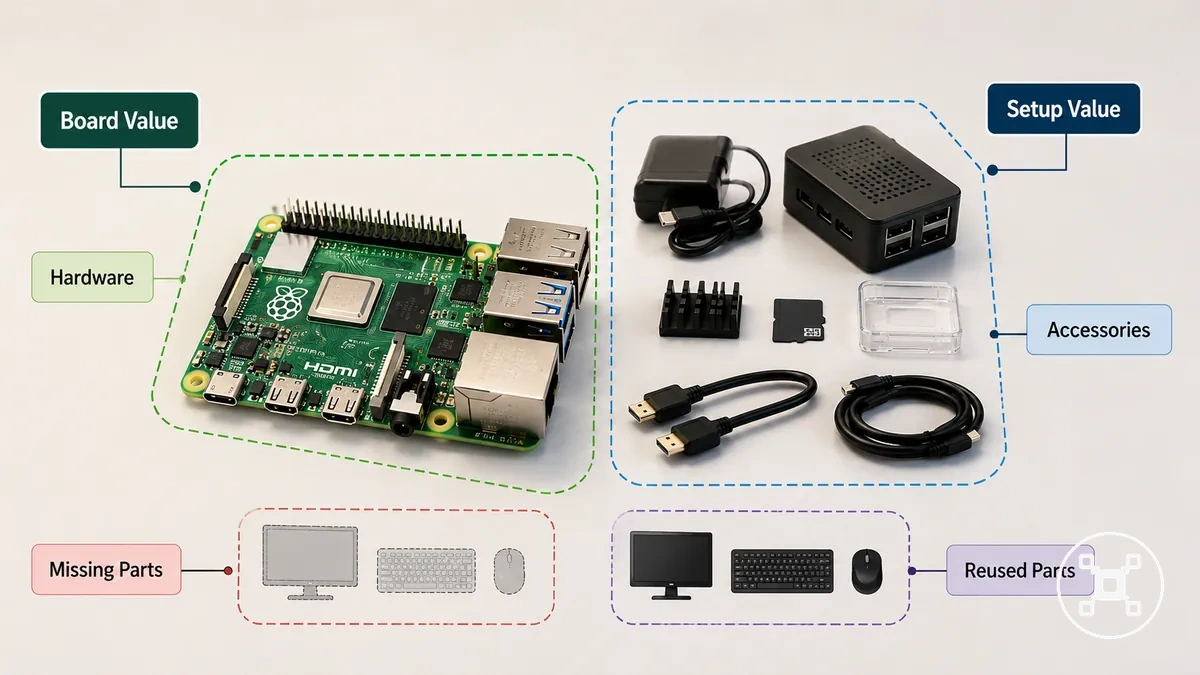
When a user has missing parts, an accessory bundle can increase setup value by reducing the number of separate accessories that need to be selected. When a user has reused parts that match the intended setup, board-only buying can preserve more accessory control. The value difference comes from whether the included parts solve a current setup need or create duplicate accessories that add limited value. For example, a kit may provide lower practical value for a user who already has suitable accessories because duplicate parts do not improve the existing setup.
When missing parts create a need for additional setup components, a bundle may provide more setup convenience.
When missing parts create a need for additional setup components, a bundle may provide more setup convenience. When reused parts already meet the setup requirements, choosing only the board can help avoid unnecessary duplication.
Convenience, control, and reuse differences
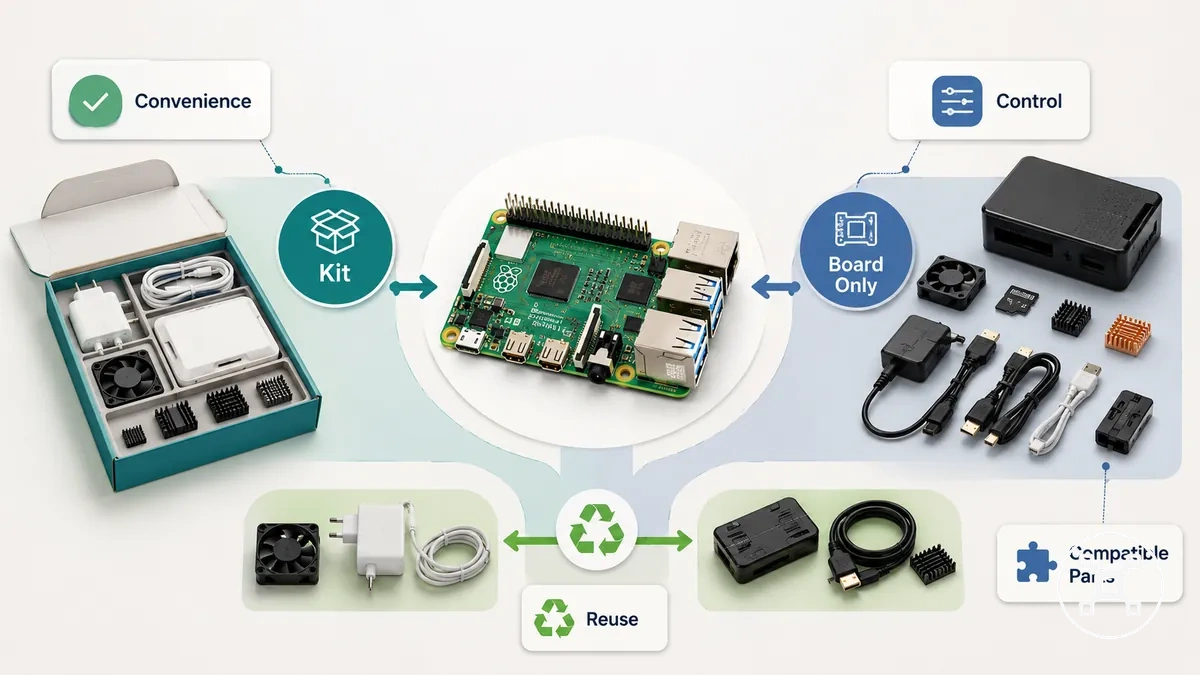
Convenience, control, and reuse highlight different priorities in a Raspberry Pi kit versus board-only decision. Convenience favors a kit when fewer choices help simplify a beginner setup, while control and reuse often favor board-only buying when compatible accessories are already available. Each criterion affects the effort required, the suitability of selected parts, and the confidence of the final setup choice.
For a project setup, control can matter more when exact parts are needed for a specific configuration.
For a beginner setup with limited compatibility knowledge, convenience can reduce the number of separate choices that need evaluation before starting. For a project setup, control can matter more when exact parts are needed for a specific configuration. Reuse can improve value when existing compatible accessories already match the intended Raspberry Pi setup. Board-only buying does not require advanced knowledge, but reused parts must fit the setup requirements and remain suitable for the intended use.
Reuse can improve value when existing compatible accessories already match the intended Raspberry Pi setup.
The following checklist separates convenience, control, and reuse by their effect on effort, waste, and decision confidence.
- Convenience: A Raspberry Pi kit supports fewer choices when a beginner setup benefits from a simpler selection process and reduced initial decision effort.
- Control: A board-only purchase supports exact parts selection when a project setup requires specific accessories or configuration choices.
- Reuse: Board-only buying can reduce unnecessary duplication when existing compatible accessories are suitable for the Raspberry Pi setup.
Raspberry Pi kit contents that affect the buying decision
Raspberry Pi kit contents matter when they affect setup readiness, accessory fit, or replacement risk. The included parts should be evaluated by whether their attributes match the intended Raspberry Pi use case and reduce the need for additional selections. A kit can provide useful value when its included components suit the setup conditions, but the result depends on the parts provided and their compatibility.
Accessory evaluation connects each part to its required attribute, fit condition, and buying effect.
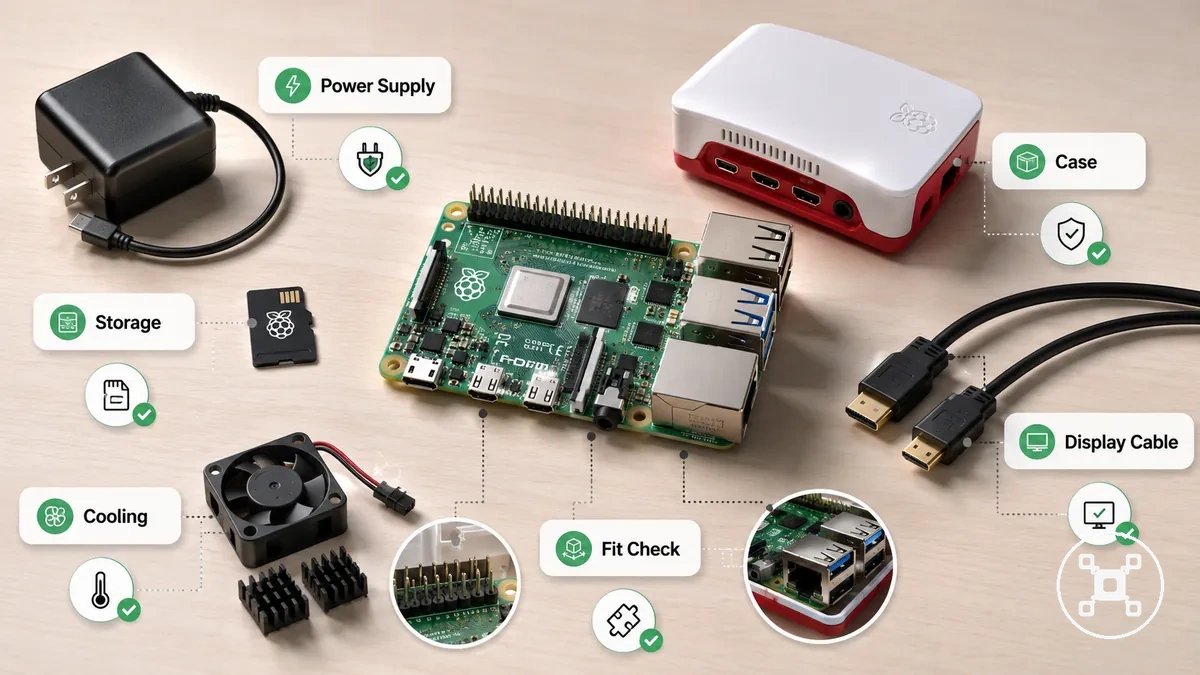
Accessory evaluation connects each part to its required attribute, fit condition, and buying effect. A power supply, storage option, case, cooling component, and display cable should be judged by their suitability for the intended setup rather than by inclusion alone. This approach identifies whether kit components improve readiness or create parts that may require replacement. This section evaluates kit value, while broader accessory planning is covered in the Raspberry Pi accessories needed guide.
The table below connects common kit components with their attributes, fit conditions, and setup effects.
Raspberry Pi kit contents can change the buying decision when included parts affect setup preparation, missing parts, or replacement risk. The table below connects common kit components with their attributes, fit conditions, and setup effects.
| Accessory | Required attribute | Fit or condition to check | Buying effect |
|---|---|---|---|
| Power supply | Power compatibility | Check whether the power supply matches the Raspberry Pi setup requirements. | A suitable power supply can support setup readiness and reduce replacement risk. |
| Storage | Storage capacity and suitability | Check whether the storage option matches the intended use and setup needs. | Suitable storage can support boot readiness and reduce replacement needs. |
| Case | Physical fit | Check whether the case matches the board layout and included components. | A suitable case can support protection and reduce fit issues. |
| Cooling | Cooling suitability | Check whether the cooling component matches the intended use conditions. | Suitable cooling can improve setup suitability for the intended use. |
| Display cable | Connector compatibility | Check whether the cable connection matches the display setup. | A suitable cable can prevent missing-part issues during setup. |
| Optional peripherals | Use-case suitability | Check whether optional parts match the intended desktop or project setup. | Relevant peripherals can add value, while unused parts may reduce bundle value. |
Power, storage, case, cooling, and display connection parts
Power supply, storage, case, cooling, and display connection parts are the accessory groups that often determine whether a Raspberry Pi kit is suitable for a specific setup. These components affect boot readiness, protection, heat control, and display connection through their rating, capacity, fit, and model compatibility.
Checking these conditions helps identify missing or unsuitable parts before setup.
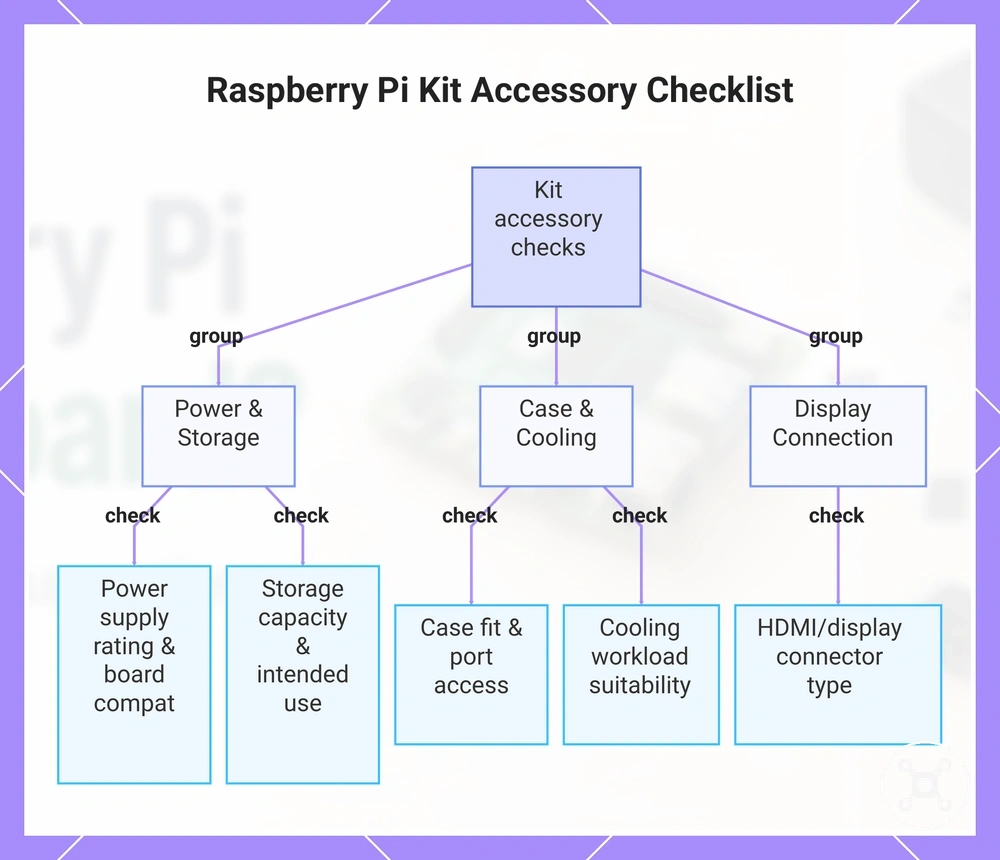
Each part requires a condition check because Raspberry Pi requirements can change by board model and intended use. A power supply should match the required rating for the board model, storage should have suitable capacity for the intended setup, and a case should match the board fit and available ports. Cooling components should suit the workload and airflow conditions, while an HDMI cable or display cable should match the required connector type. Checking these conditions helps identify missing or unsuitable parts before setup.
Each part requires a condition check because Raspberry Pi requirements can change by board model and intended use.
The checklist below verifies setup-ready parts by connecting each accessory group to its main condition and decision risk.
- Power supply: Check the rating and board model compatibility because an unsuitable power supply can affect setup stability.
- Storage: Check storage capacity and intended use suitability because unsuitable storage can affect boot readiness.
- Case: Check case fit and available ports because an unsuitable enclosure can create protection or assembly issues.
- Cooling: Check cooling suitability for the workload because heat control needs can change with usage conditions.
- Display connection: Check the HDMI cable or display cable connector because the connection type must match the display setup.
This chart groups the key accessory checks for a Raspberry Pi kit, showing the conditions to verify for power, storage, case, cooling, and display connection parts.
Accessories that may still be missing from a complete kit
A complete Raspberry Pi kit can mean that the setup is boot-ready rather than project-ready. Missing accessories can change the real cost and readiness of a setup when the intended use requires parts beyond the included components. The word complete depends on the use case, included parts, and the type of setup being created.
A complete Raspberry Pi kit can mean that the setup is boot-ready rather than project-ready.
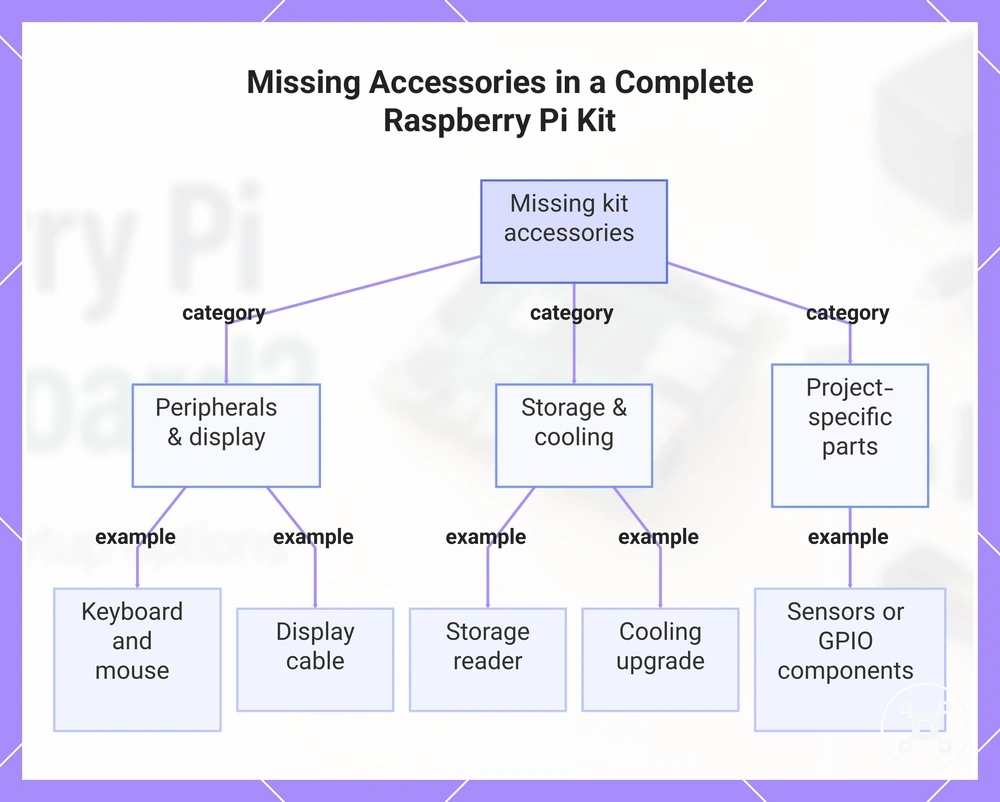
For a desktop setup or project use, a complete kit may still require additional parts that are not included because they relate to a specific need. Peripherals, display connection parts, storage readers, cooling upgrades, and project-specific parts can create a setup gap when they are needed for the chosen use. These missing accessories are not necessarily a problem with the kit; they show the difference between a boot-ready starting point and a project-ready setup.
The missing items affect the decision because they add additional parts to consider for that specific setup.
For example, a kit may provide the parts needed to start a Raspberry Pi system but still require project-specific components when the user adds a custom use case. The missing items affect the decision because they add additional parts to consider for that specific setup.
The checklist below identifies missing items that can change readiness and real cost.
The checklist below identifies missing items that can change readiness and real cost.
- Peripherals: Keyboard, mouse, or similar input devices may matter for desktop use because a boot-ready kit may not include the parts needed for daily interaction.
- Display connection: A display cable may be needed when the chosen screen connection is not included, which can affect immediate setup readiness.
- Storage reader: A storage reader may matter when separate storage management is needed, adding another part to the setup requirements.
- Cooling upgrade: A cooling upgrade may become relevant for higher-workload use cases because heat control needs can change with workload and enclosure conditions.
- Project-specific parts: Additional parts such as sensors or GPIO-related components may be needed for a chosen project because general kits are not designed for every custom use.
This chart shows the categories of accessories that may be missing from a 'complete' Raspberry Pi kit, affecting setup readiness and real cost.
When a Raspberry Pi starter kit is the safer choice
A Raspberry Pi starter kit is a safer choice when a beginner lacks suitable parts and needs fewer compatibility checks before a first setup. A starter kit can reduce the chance of missing a required part when its included accessories match the intended Raspberry Pi model and use case. This lower-risk option comes from reduced setup decisions, not from a guarantee that every kit will suit every situation.
This lower-risk option comes from reduced setup decisions, not from a guarantee that every kit will suit every situation.
For a beginner or first-boot scenario, a Raspberry Pi starter kit can reduce uncertainty by grouping matched accessories and simplifying the initial selection process. When the buyer has limited experience checking compatible parts, fewer separate choices can improve confidence during setup preparation. The benefit comes from having suitable components available together, while the included parts still need to match the intended setup requirements.
Myth to truth: A safer choice is not the same as universal compatibility.
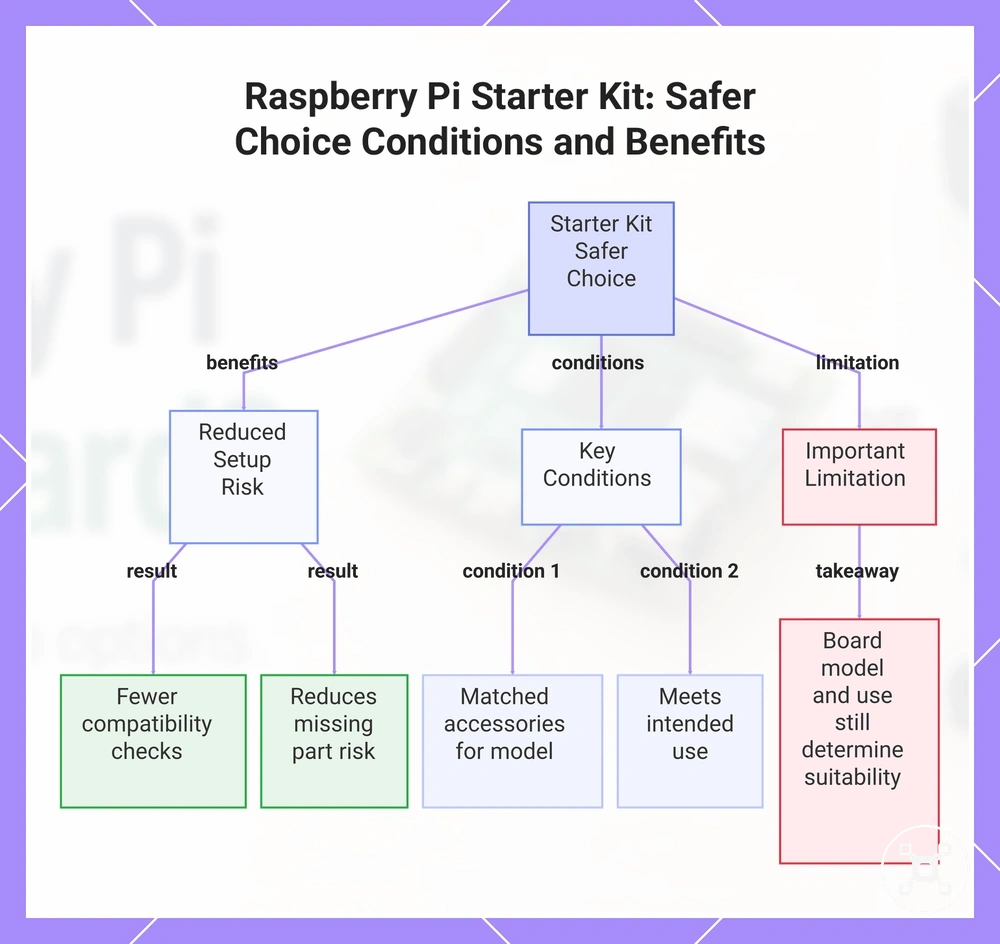
Myth to truth: A safer choice is not the same as universal compatibility. A starter kit may reduce setup risk through matched accessories and fewer checks, but board model fit and intended use still determine whether the bundle is suitable.
The checklist below identifies safer-choice conditions that reduce setup risk compared with assembling a board-only setup.
The checklist below identifies safer-choice conditions that reduce setup risk compared with assembling a board-only setup.
- Beginner setup: A Raspberry Pi starter kit may be a safer choice when a buyer needs fewer choices because reduced selection effort can lower compatibility check burden.
- First boot readiness: A starter kit may reduce missing required part risk when included components match the intended first setup requirements.
- Matched accessories: A starter kit can reduce setup risk when included accessories fit the selected Raspberry Pi model and avoid separate accessory matching.
- Compatibility checks: A starter kit may suit buyers who want fewer individual checks before starting because grouped parts simplify the initial decision.
- Existing parts: A board-only purchase may be suitable when the buyer already has compatible accessories and knows the required parts for the setup.
This chart shows the benefits, key conditions, and limitation of choosing a Raspberry Pi starter kit as a safer option for beginners.
First setup, beginner use, and fewer compatibility checks
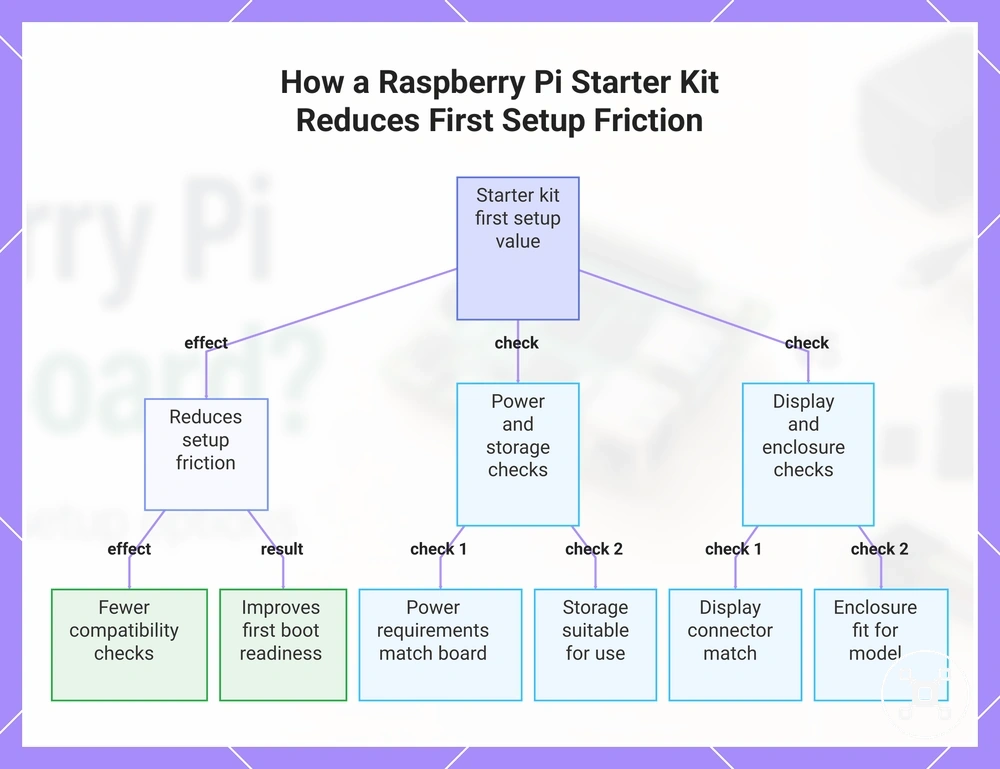
First setup and beginner use often increase the value of matched accessories because a Raspberry Pi starter kit can reduce the number of compatibility checks needed before choosing parts. Matched power, storage, display, and enclosure components can improve setup confidence when they suit the intended Raspberry Pi model. The value comes from reducing selection friction, not from removing the need to verify compatibility.
The value comes from reducing selection friction, not from removing the need to verify compatibility.
For a new user, fewer compatibility checks can reduce research effort and setup friction before the first boot. A Raspberry Pi starter kit may provide better first boot readiness when the included parts match the intended use and board requirements. This approach helps reduce uncertainty around selecting matched parts without replacing setup guidance. The exact Raspberry Pi model still needs to be checked because enclosure fit, power requirements, and accessory compatibility can differ between models.
For the next steps after selecting compatible parts, see the first Raspberry Pi setup guide.
For the next steps after selecting compatible parts, see the first Raspberry Pi setup guide.
The checklist below verifies beginner setup readiness by focusing on the main compatibility checks that affect confidence and part matching.
The checklist below verifies beginner setup readiness by focusing on the main compatibility checks that affect confidence and part matching.
- Power: Check matched power compatibility with the exact Raspberry Pi model because suitable power selection supports reliable setup preparation.
- Storage: Check storage suitability for the intended use because the included storage option affects first boot readiness.
- Display: Check the display connection and connector match because a suitable display setup avoids additional part selection.
- Enclosure: Check enclosure fit with the exact Raspberry Pi model because board dimensions and ports affect compatibility.
This chart explains the benefits of a starter kit for first-time Raspberry Pi setup and the key compatibility checks that ensure a smooth first boot.
Desktop-style use versus project-style use
Desktop-style use often values bundled peripherals, while project-style use may require custom parts that better match the intended build. A Raspberry Pi kit can be more useful when included display, keyboard, mouse, storage, case, and cooling parts support the planned setup. Project-style use may place more value on selecting specific sensors, GPIO parts, custom cases, or custom power choices instead of general bundled accessories.
The better option depends on which parts provide useful value for the chosen use case.
For a desktop-style setup, bundled parts may reduce selection effort when common peripherals improve readiness for everyday use. For a project-style setup, required parts can change based on the purpose of the build and whether included components match the intended requirements. A board-only purchase may be preferable when a bundle contains irrelevant desktop parts that do not contribute to the project setup. The better option depends on which parts provide useful value for the chosen use case.
The table below compares Desktop-style use versus project-style use and shows how required parts can change kit usefulness.
The table below compares Desktop-style use versus project-style use and shows how required parts can change kit usefulness.
| Use style | Parts that matter | Kit advantage | Board-only advantage |
|---|---|---|---|
| Desktop-style use | Display, keyboard, mouse, storage, case, and cooling | A Raspberry Pi kit may reduce accessory selection effort when bundled peripherals match the desktop setup. | A board-only purchase allows selection of preferred peripherals when existing parts or specific choices are needed. |
| Project-style use | Sensors, GPIO parts, custom case, and custom power | A Raspberry Pi kit may help when included parts match the project requirements. | A board-only purchase may provide more control when bundled parts are irrelevant and custom components are required. |
When buying the Raspberry Pi board only makes more sense
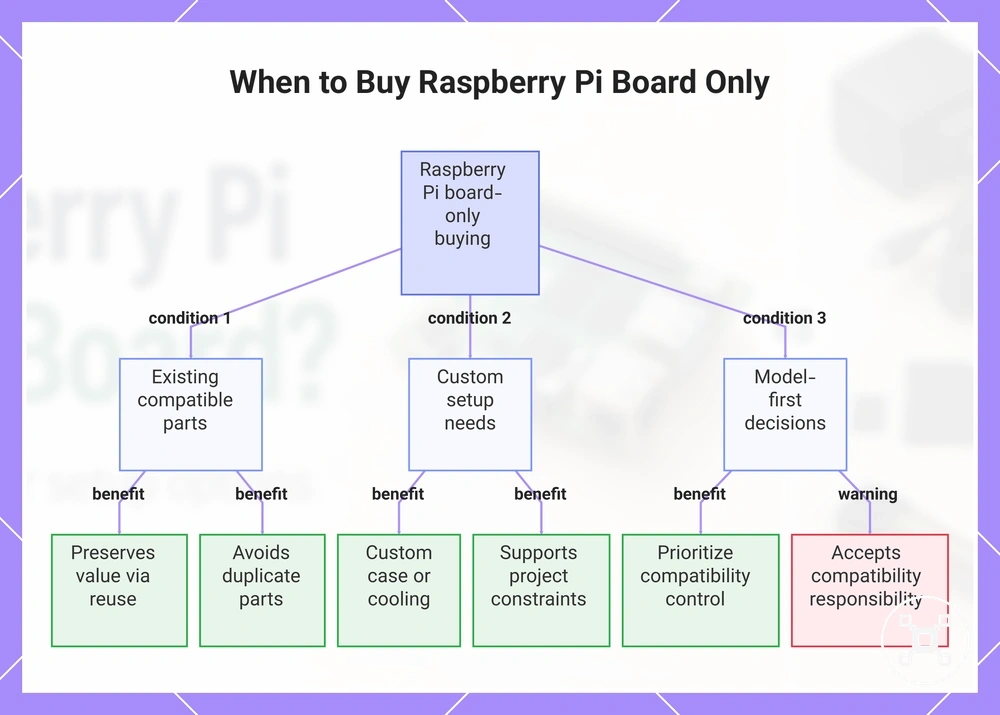
Buying the Raspberry Pi board only makes more sense when existing compatible owned accessories, custom requirements, or specific fit needs make separate selection more valuable than bundled parts. Board only buying can provide more control over the final setup when the user already has suitable components or needs custom selection. This option can reduce duplicate parts when reused accessories are appropriate, but it increases compatibility responsibility because the buyer must check each separate component.
This approach can improve fit when the included parts do not match the intended use.
For users with compatible owned accessories, board only buying can preserve value by allowing reuse instead of selecting duplicate bundled parts. For custom needs, separate selection can support choices such as a custom case, storage choice, cooling preference, or other setup requirements that differ from a general bundle. This approach can improve fit when the included parts do not match the intended use. The decision depends on whether the selected parts remain compatible with the Raspberry Pi setup.
The decision depends on whether the selected parts remain compatible with the Raspberry Pi setup.
Myth to truth: Board-only buying can reduce waste when suitable parts are already available, but it does not remove planning work. The buyer takes on compatibility responsibility because separate parts must match the intended Raspberry Pi model and setup requirements.
The following groups identify when Raspberry Pi board only buying may provide more control, value, or fit.
The following groups identify when Raspberry Pi board only buying may provide more control, value, or fit.
- Existing compatible parts:
- Compatible owned accessories can make board only buying more suitable because reuse can preserve value and avoid duplicate parts.
- Existing storage or peripherals that match the intended setup can reduce the need for bundled replacements.
- Custom setup needs:
- A custom case can provide better fit when a standard bundled enclosure does not match the required setup conditions.
- A preferred cooling preference can matter when the selected setup has specific workload or enclosure requirements.
- Custom selection can support project constraints when included bundle parts are not relevant to the intended use.
- Model-first decisions:
- Choosing the Raspberry Pi model first can help users select parts based on required compatibility rather than adapting to bundled components.
- Board-only buying can suit users who prioritize control over included parts and accept the additional compatibility responsibility.
This chart shows the three main scenarios where buying only the Raspberry Pi board (without a bundle) provides more control, value, or fit.
Existing accessories, custom cases, and specific project requirements
Users with existing accessories may find board-only buying more efficient when owned parts can be verified for fit and quality. A reusable power supply, storage, cables, and other reused accessories can add value when they match the intended Raspberry Pi setup. Custom cases and specific project requirements can also make separate selection more suitable when bundled parts do not match the required use.
Verifying parts before reuse helps reduce the risk of replacing unsuitable components later.
When existing accessories or custom parts are considered, the main decision is whether each component remains suitable for the setup. A reusable power supply should be checked for compatibility and condition before reuse, while storage and cables should be reviewed for fit and quality. Custom cases and cooling choices should match the board and intended conditions to maintain the board-only advantage. Verifying parts before reuse helps reduce the risk of replacing unsuitable components later.
The checklist below verifies whether existing or custom parts justify board-only buying.
The checklist below verifies whether existing or custom parts justify board-only buying.
- Reusable power supply: Verify the power supply rating and suitability before reuse because an unsuitable part can reduce the value of using existing accessories.
- Storage: Verify storage compatibility and condition because unsuitable reused storage may create additional replacement needs.
- Cables: Verify cable compatibility and quality because incorrect or unsuitable cables can remove the benefit of reusing existing parts.
- Custom cases: Verify enclosure fit because a custom case only provides value when it matches the board and required layout.
- Cooling choices: Verify cooling suitability because the selected cooling approach should match the intended workload and enclosure conditions.
- Project requirements: Verify custom add-ons because specific project requirements can make separate components more suitable than bundled parts.
Edge case: Reusing an older accessory that does not match the required setup can remove the board-only advantage by creating additional replacement work instead of reducing waste.
Model choice before accessory bundling
Model choice comes before accessory bundling because the Raspberry Pi model determines whether a kit's included parts are suitable for the intended setup. Selecting the Raspberry Pi model first helps define accessory fit and bundle suitability before comparing included components. The selected model provides the reference point for checking compatible cases, cables, power options, and cooling needs.
The model generation can affect the port layout, which influences cable and case compatibility.
Definition-first, bundle fit depends on model-related factors rather than the bundle label alone. The model generation can affect the port layout, which influences cable and case compatibility. The power connector should match the selected Raspberry Pi model and related power supply requirements, while cooling need can change based on the intended workload. Case compatibility and accessory match should be checked against the selected board version before judging whether a kit bundle is suitable.
For broader guidance on selecting a suitable board, see the choose a Raspberry Pi guide.
Model choice is upstream of kit evaluation, so users should identify the required board version before comparing accessory bundling. For broader guidance on selecting a suitable board, see the choose a Raspberry Pi guide.
Compatibility checks before choosing a kit or separate parts
Compatibility checks should happen before choosing a Raspberry Pi kit or separate parts because accessory suitability depends on the selected setup conditions. Checking the Raspberry Pi model, power rating, storage type, case fit, cooling clearance, cable connection, and intended setup can reduce the risk of mismatched accessories before purchase. These checks help identify potential replacement costs when included or separate parts do not match the required setup.
These checks help identify potential replacement costs when included or separate parts do not match the required setup.
Problem to solution: mismatched accessories can create hidden replacement costs when parts do not meet the intended setup requirements. A Raspberry Pi model should be considered first because accessory conditions can change with the selected board version. Power rating and connector requirements should be checked for the chosen setup, while storage type should match the intended use and readiness needs. Case fit, cooling clearance, and cable connection should also be reviewed because unsuitable matches can reduce the value of the selected kit or separate parts.
A Raspberry Pi model should be considered first because accessory conditions can change with the selected board version.
Definition-first, compatibility checks follow an entity-attribute-value approach where the Raspberry Pi model is the entity, accessory characteristics are attributes, and the required conditions determine the decision effect. The model identifies the board context, each accessory attribute identifies what must match, the condition defines suitability, and the result shows whether a kit or separate parts better fit the intended setup.
The checklist below verifies fit before purchase by connecting each compatibility condition to its risk and decision effect.
The checklist below verifies fit before purchase by connecting each compatibility condition to its risk and decision effect.
| Check | Required condition | Risk if wrong | Decision effect |
|---|---|---|---|
| Raspberry Pi model | The selected model should be the reference point for accessory matching. | Incorrect accessory matching can create additional replacement costs. | Helps determine whether a kit or separate parts suit the setup. |
| Power rating | The power rating and connector requirements should match the selected setup. | An unsuitable power option can create compatibility concerns. | Supports a more informed part selection decision. |
| Storage type | The storage type should match the intended setup requirements. | Unsuitable storage may reduce readiness or require another choice. | Helps evaluate included or separate storage options. |
| Case fit | The case should match the selected board layout and required access points. | Poor fit can make the enclosure unsuitable. | Supports choosing a suitable case option. |
| Cooling clearance | Cooling clearance should match the selected setup and intended workload. | Limited clearance can reduce accessory suitability. | Helps assess whether cooling choices fit the setup. |
| Cable connection | The cable connection should match the intended connected accessory. | An unsuitable cable can create additional replacement needs. | Helps prevent avoidable accessory mismatch. |
| Intended setup | The selected parts should align with the planned use case. | Unused or unsuitable parts can increase overall cost. | Helps choose between bundled and separate parts. |
Board model, power rating, storage type, and case fit
These compatibility checks catch common kit-fit problems because the main board attributes must align with accessory conditions before a kit is suitable. The board model, power rating, storage type, connector type, and case fit are the highest-risk areas to review before choosing bundled or separate parts. Checking these conditions helps identify possible replacement costs when the kit label does not match the exact board version.
The kit label should be checked against the exact board version before purchase.
Definition-first, compatibility checks connect a board attribute to an accessory condition and a decision effect. The board model identifies the supported version, the power requirement connects to the power rating and connector type, and the storage type connects to the required storage medium. Case dimensions affect enclosure fit and port access, while the final fit outcome depends on whether the accessory condition matches the selected board version. The kit label should be checked against the exact board version before purchase.
| Board attribute | Accessory condition | What to check | Decision risk |
|---|---|---|---|
| Board model | The kit should identify compatibility with the selected board version. | Check the kit label against the exact Raspberry Pi model. | An unsuitable bundle may include parts that do not match the selected board. |
| Power rating | The power requirement and connector type should match the selected setup. | Check the power rating and power connection condition. | A mismatch can create replacement needs for unsuitable power parts. |
| Storage type | The storage medium should match the intended setup requirements. | Check the storage type and storage format condition. | An unsuitable storage choice can reduce setup readiness. |
| Connector type | Cables and connected accessories should match available connections. | Check connector type before selecting the kit or separate parts. | An incompatible connection can require additional accessory changes. |
| Case dimensions | The enclosure should match the board layout and required access points. | Check case dimensions, port access, and case fit. | Poor enclosure fit can make the kit unsuitable for the selected board. |
Cooling and cable needs that vary by setup
Cooling needs and cable needs depend on setup conditions rather than being automatically solved by a kit. Workload, enclosure choice, display setup, and board model can change the required cooling and cable checks. These conditions help determine whether included parts match the intended setup before choosing bundled or separate components.
Cooling needs and cable needs depend on setup conditions rather than being automatically solved by a kit.
Scenario-first, a light desktop use setup may have different cooling and cable needs from an enclosed case or a higher-load project. An enclosure with limited airflow may require closer attention to heat control, fan or heatsink presence, and case airflow conditions. A display setup requires checking cable type, cable length, and connector fit against the board model and connected display. Higher workload conditions may increase cooling needs, while lighter workloads may require fewer cooling considerations. A final check should confirm that the included cooling and cable components match the specific setup conditions.
A final check should confirm that the included cooling and cable components match the specific setup conditions.
The checklist below verifies setup-dependent cooling and cable conditions by connecting each condition to a likely check and decision effect.
- Workload: Higher workload conditions may increase cooling needs because heat control requirements can change with usage intensity. Check whether fan or heatsink support matches the intended workload.
- Enclosure: A closed enclosure may require airflow checks because case airflow conditions can affect cooling suitability. Check enclosure space before relying on included cooling components.
- Board model: Cooling and cable fit may depend on the board model because accessory compatibility can differ between board versions. Check the board model before selecting included parts.
- Display setup: A display setup requires checking cable type and connector fit because the connection must match the display and board conditions.
- Cable length: Cable length should match the physical arrangement because an unsuitable length can affect whether the display connection is practical.
Cost and value tradeoffs between a kit and separate accessories
The value of a Raspberry Pi kit depends on the included parts, missing parts, and duplicate items within the setup rather than the bundle format alone. A kit may provide more value when its components match the intended use and reduce additional selection effort. Separate accessories may provide more value when suitable parts are already available or when specific component choices are more important than bundled convenience.
Comparing the complete setup requirement helps evaluate the practical value of each route.
Problem to solution: total setup cost includes more than the upfront price because missing parts, duplicate items, and replacement needs can change the overall value. A Raspberry Pi kit may reduce effort during first setup by grouping components, while separate accessories can provide more replacement flexibility when individual parts need to be selected. Accessory quality also affects the cost-value tradeoff because unsuitable components may reduce the usefulness of the bundle. Comparing the complete setup requirement helps evaluate the practical value of each route.
Accessory quality also affects the cost-value tradeoff because unsuitable components may reduce the usefulness of the bundle.
The table below compares Cost and value tradeoffs between a kit and separate accessories by showing how each cost factor affects total value.
| Cost factor | Kit route | Separate-accessory route | Decision effect |
|---|---|---|---|
| Upfront price | A kit combines selected components into one purchase route. | Separate accessories allow individual component choices. | The value depends on whether the selected parts match the intended setup. |
| Included parts | Included parts can add value when they match the required setup. | Separate parts allow selection based on current requirements. | Relevant included parts can improve bundle value, while unsuitable parts may reduce it. |
| Duplicate items | A kit may include parts that overlap with existing accessories. | Separate accessories can support reuse of suitable owned parts. | Avoiding unnecessary duplicates can reduce wasted cost. |
| Accessory quality | Bundle components should be evaluated by their suitability for the intended setup. | Individual selection allows attention to specific component requirements. | Accessory quality influences the practical value of each route. |
| Replacement flexibility | A kit may simplify selection but can limit individual component choices. | Separate accessories allow individual parts to be changed when requirements differ. | Flexibility can affect long-term setup value. |
| Convenience value | A kit can reduce selection effort during first setup. | Separate accessories require more individual decisions. | Reduced effort can add value when convenience is a priority. |
Using these tradeoff criteria helps compare total setup cost before considering product examples. For broader guidance on evaluating cost and value factors, see the Raspberry Pi cost and value guide.
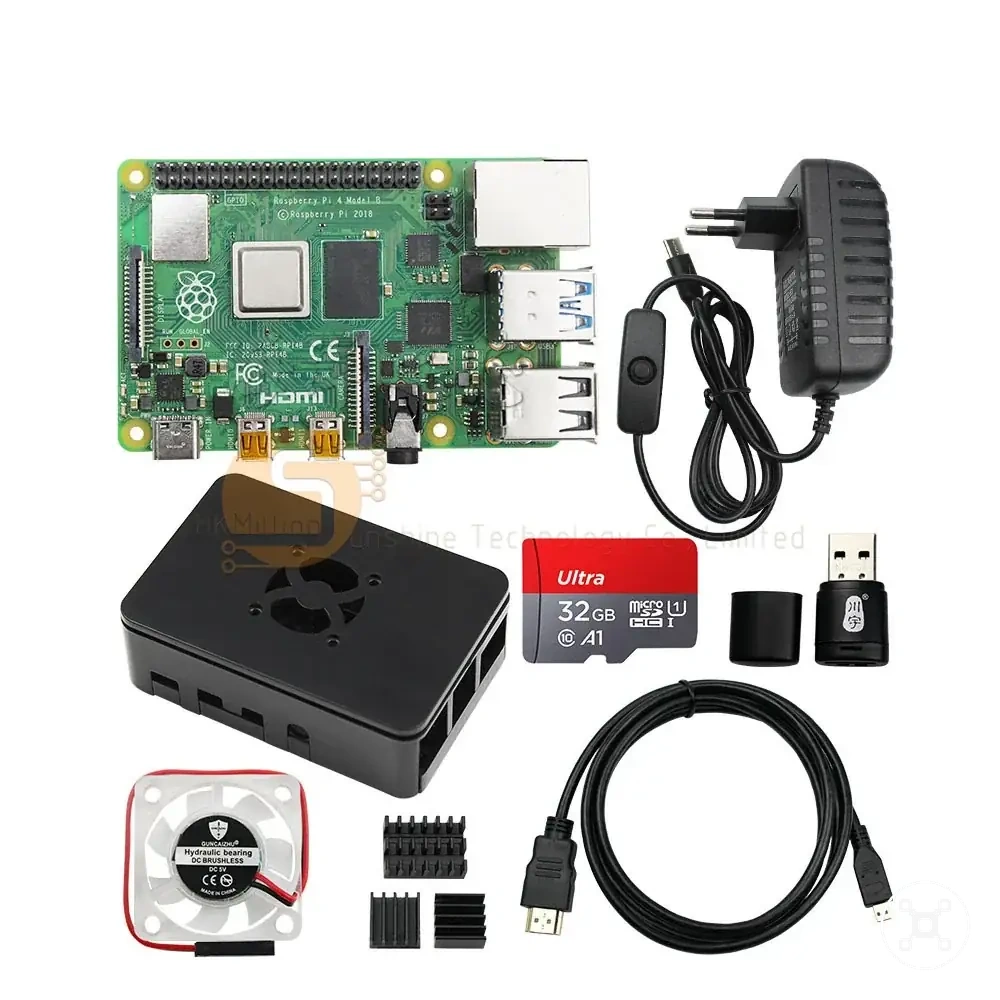
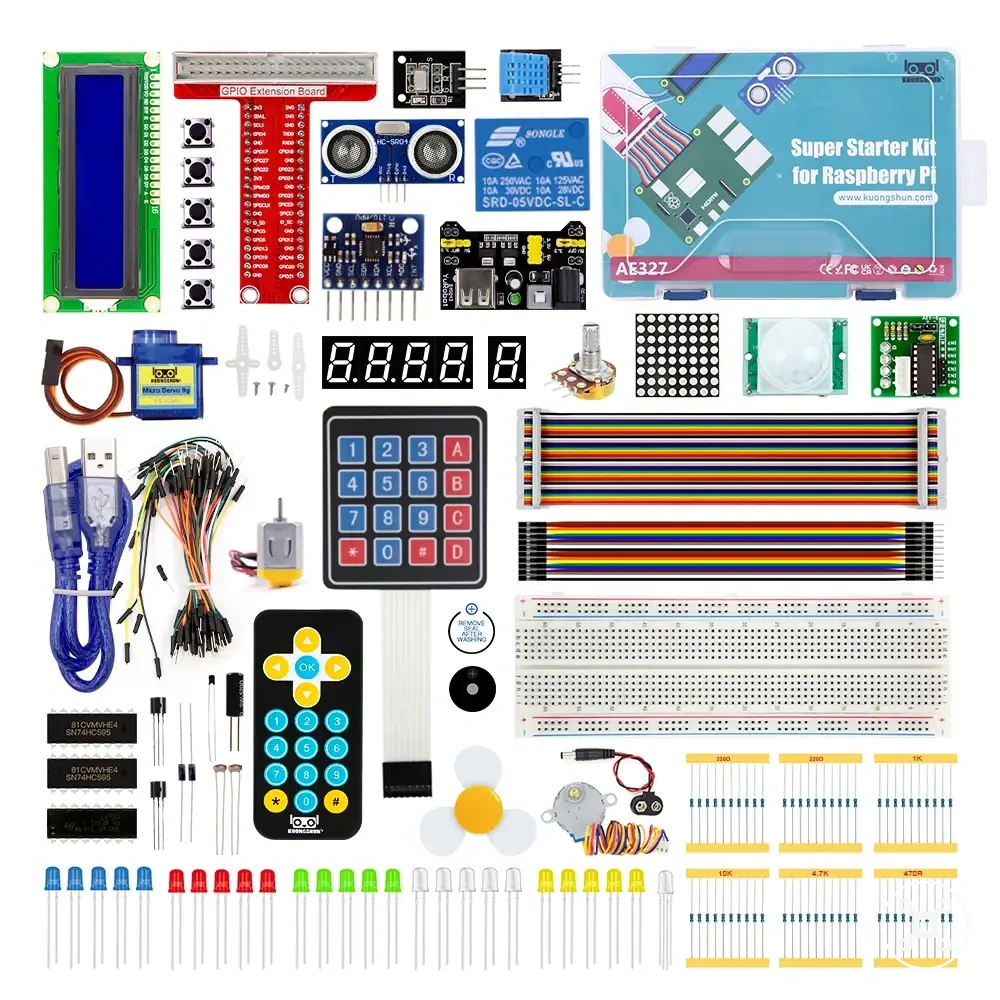
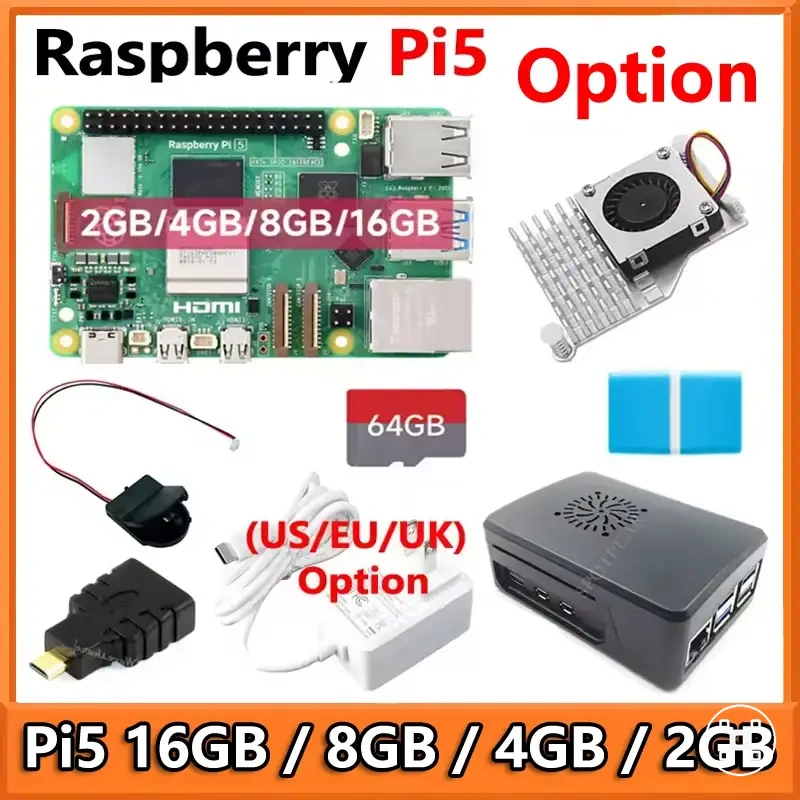
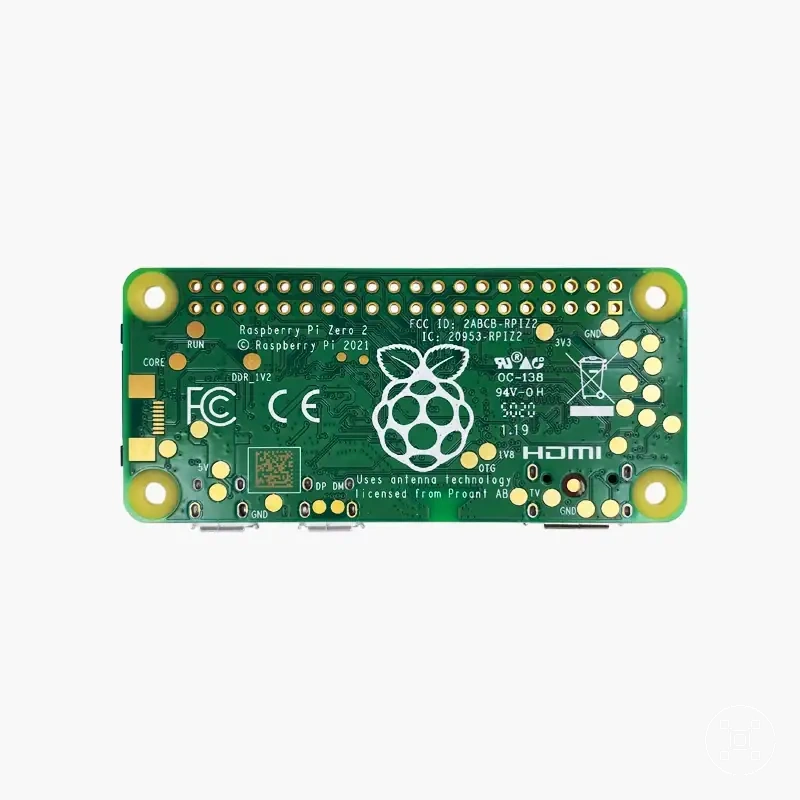
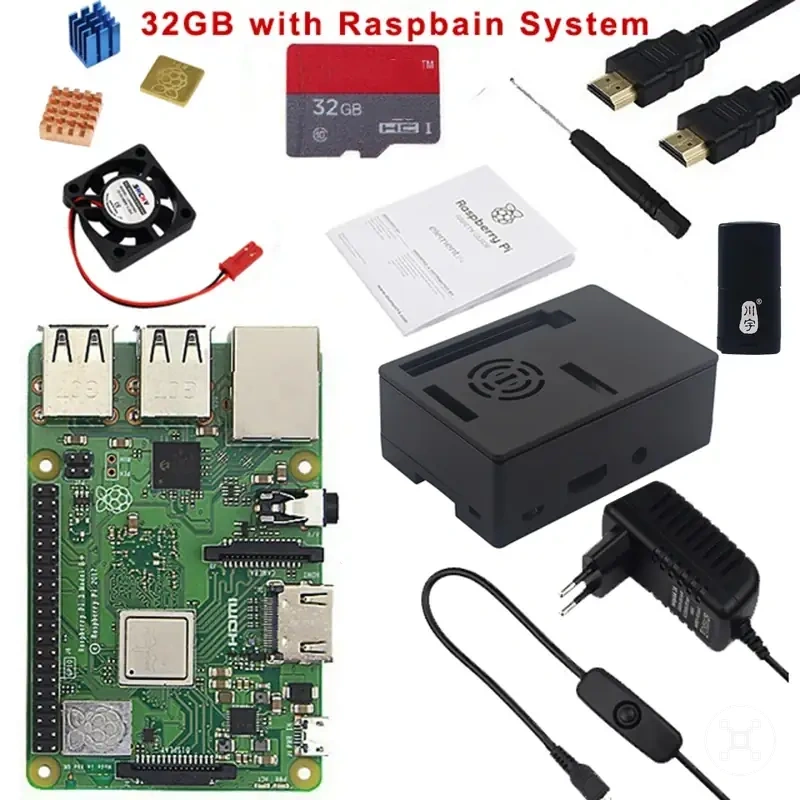
The products below are useful examples for comparing available options.
The products below are useful examples for comparing available options. Before buying, check that the compatibility criteria, key features, and product details match your needs.
Upfront bundle price versus duplicate or unused parts
Problem to solution: duplicate parts and unused accessories can create a value risk when an upfront bundle price includes components that do not match the user's existing setup. A Raspberry Pi kit may provide lower value when owned accessories already cover included parts or when missing upgrades are still needed separately. The cost decision depends on whether the bundle reduces first-setup friction enough to justify the included components.
The cost decision depends on whether the bundle reduces first-setup friction enough to justify the included components.
Scenario-first, a kit can remain worthwhile when first-setup friction is reduced enough to matter, even if one included accessory is not used later. For example, a user starting without owned accessories may value having the required starting components together more than the unused item creates a cost concern. A user with suitable owned accessories may place more value on avoiding duplicate parts and selecting specific upgrades separately. The final value depends on the bundle cost, accessory quality, and how well the included components match the intended setup.
The final value depends on the bundle cost, accessory quality, and how well the included components match the intended setup.
The checklist below evaluates Upfront bundle price versus duplicate or unused parts by testing whether unused parts weaken bundle value.
- Bundle price: Check whether the upfront bundle price includes useful components because unused accessories can increase value risk when they do not support the intended setup.
- Owned accessories: Check whether existing accessories already cover included components because duplicate parts can reduce the benefit of buying a bundle.
- Accessory quality: Check whether included components meet the required setup needs because lower suitability can affect replacement decisions.
- Missing upgrades: Check whether additional upgrades are still required because missing components can change the total setup cost.
- Unused accessories: Check whether unused items provide practical value because components that do not support the setup can weaken bundle value.
Replacement flexibility versus matched accessory convenience
Replacement flexibility supports future upgrade choices, while matched accessory convenience reduces current decision burden during setup. Separate accessories can provide more control over replacement timing and future reuse when individual components need to change. A matched kit can reduce the number of choices required at the beginning when a simpler setup process has more value.
The key decision signal is whether expected future changes outweigh the benefit of reduced decision burden.
Scenario-first, users expecting later changes to storage, cooling, or case parts may value replacement flexibility because separate accessories allow individual upgrade choices. A user focused on first setup may value matched accessory convenience because reduced choices can simplify the initial decision. Accessory quality and compatibility confidence can influence either route because component suitability affects the overall value decision. The key decision signal is whether expected future changes outweigh the benefit of reduced decision burden.
A user focused on first setup may value matched accessory convenience because reduced choices can simplify the initial decision.
The table below compares Replacement flexibility versus matched accessory convenience by showing the tradeoff between flexibility and convenience.
| Separate-accessory flexibility | Matched-kit convenience |
|---|---|
| Replacement timing: Separate accessories allow individual components to be considered when replacement needs arise. | Replacement timing: A matched kit provides a grouped starting setup that can reduce initial selection effort. |
| Upgrades: Separate accessories can support different upgrade choices when future storage, cooling, or case changes are expected. | Upgrades: A matched kit reduces initial choices but may provide less individual selection control. |
| Quality control: Separate accessories allow attention to specific accessory quality requirements. | Quality control: Included components should be evaluated by how well they match the intended setup. |
| Compatibility confidence: Separate accessories require checking whether selected parts match the setup conditions. | Compatibility confidence: A matched kit can reduce decision burden when included components suit the intended setup. |
| Future reuse: Separate accessories can support reuse decisions when setup requirements change. | Future reuse: A matched kit can provide convenience when fewer decisions are preferred for the current setup. |
Choosing the better Raspberry Pi starter option for your situation
The better starter option depends on the user's situation, because a Raspberry Pi starter kit and board only approach suit different levels of setup readiness, existing accessories, compatibility confidence, and use case. A Raspberry Pi starter kit may suit a beginner setup when reduced choices and initial readiness are the priority. Board only may suit users who already have suitable existing accessories or need more control over accessory selection.
A Raspberry Pi starter kit may suit a beginner setup when reduced choices and initial readiness are the priority.
Scenario-first, a beginner setup may benefit from a starter kit when fewer decisions improve confidence during the first setup. Desktop-style use may suit a kit when the included components match the intended use case and required setup needs. Users with existing accessories may prefer board only when reuse provides more value and avoids unnecessary parts. Project-specific needs may also favour board only when control over accessory choice matters more than bundled convenience.
Users with existing accessories may prefer board only when reuse provides more value and avoids unnecessary parts.
The checklist below converts Choosing the better Raspberry Pi starter option for your situation into a situational recommendation by connecting each situation to a suitable buying route.
| Situation | Better starter option | Why it fits | Check before choosing |
|---|---|---|---|
| Beginner setup | Raspberry Pi starter kit | A starter kit may reduce setup decisions when setup readiness and fewer choices are important. | Check included parts, accessory quality, and compatibility confidence. |
| Desktop-style use | Raspberry Pi starter kit or board only | The suitable route depends on whether included parts or selected accessories better match the desktop use case. | Check total cost and whether required accessories are already available. |
| Reused accessories | Board only | Board only may provide more value when existing accessories can be reused for the intended setup. | Check compatibility confidence before using existing components. |
| Project-specific build | Board only | Board only may provide more control when project-specific needs require different accessory choices. | Check whether separate accessories match the planned use case. |
| Cost-sensitive buying | Depends on setup needs | The better route depends on total cost, included parts, and accessory quality. | Compare the complete setup requirement rather than only the initial purchase route. |
A Raspberry Pi starter kit may be the better starter option when setup readiness and reduced choices matter most. Board only may be the better starter option when existing accessories, reuse, or specific accessory control provide more value for the intended use case.
Before buying, check that the compatibility criteria, key features, and product details match your needs.
The products below are useful examples for comparing available options. Before buying, check that the compatibility criteria, key features, and product details match your needs.