mmWave Presence Sensors Explained
A mmWave presence sensor is a radar-based occupancy device that uses millimeter-wave radar to interpret reflected signal changes associated with human presence detection. The sensor connects radar signals with occupancy decisions by identifying patterns that may indicate people within a space, including stationary people who create small movements such as micro-movement.
A mmWave presence sensor works through radar-based presence sensing rather than relying only on obvious movement. Its detection behavior depends on sensor design, placement, sensitivity settings, and room conditions, so the ability to identify occupancy can vary between environments. This makes it different from basic motion detection, which typically focuses on movement changes rather than ongoing presence signals.
Understanding mmWave presence sensors starts with their role as human presence radar sensors that use mmWave radar concepts to interpret occupancy. The following sections cover what the sensor means, how its detection logic operates, why stationary people may still create detectable signals, and which detection limits shape practical use.
What a mmWave Presence Sensor Is
A mmWave presence sensor is a device that uses millimeter-wave radar signals to infer human occupancy through radar-based presence detection. The sensor interprets radar signal changes to determine an occupancy state, focusing on human presence rather than the presence of a connected device.
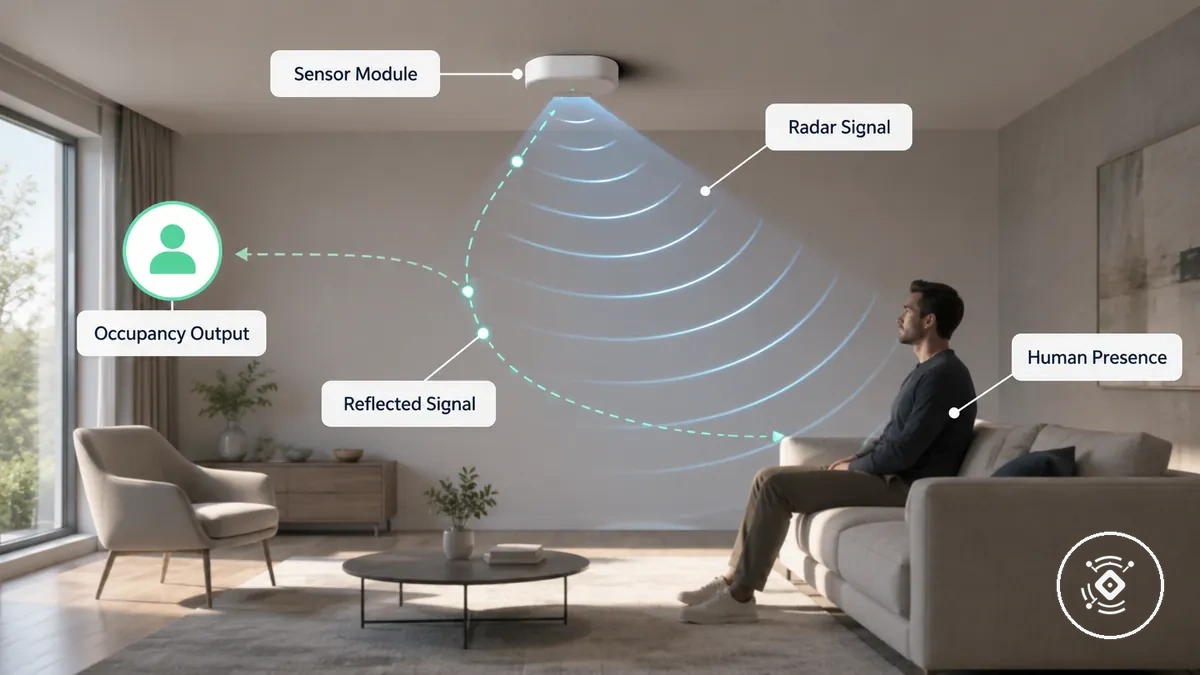
A mmWave presence sensor connects radar sensing with an automation output by processing information from the sensing area. The sensor, radar signal, occupant, and output each represent different parts of the process: the sensor captures signal changes, the radar signal carries the sensing information, the occupant creates the relevant conditions, and the output represents the interpreted occupancy state. The exact behavior can vary by sensor design and configuration.
A mmWave presence sensor is not a system for identifying a person or detecting a connected device. Some designs may combine mmWave sensing with inputs such as PIR, light, or temperature sensors, but these combinations depend on the specific device and do not change the core definition of radar-based human presence sensing. For a broader overview of this category, see the mmWave presence sensor guide.
How mmWave Radar Detects Human Presence
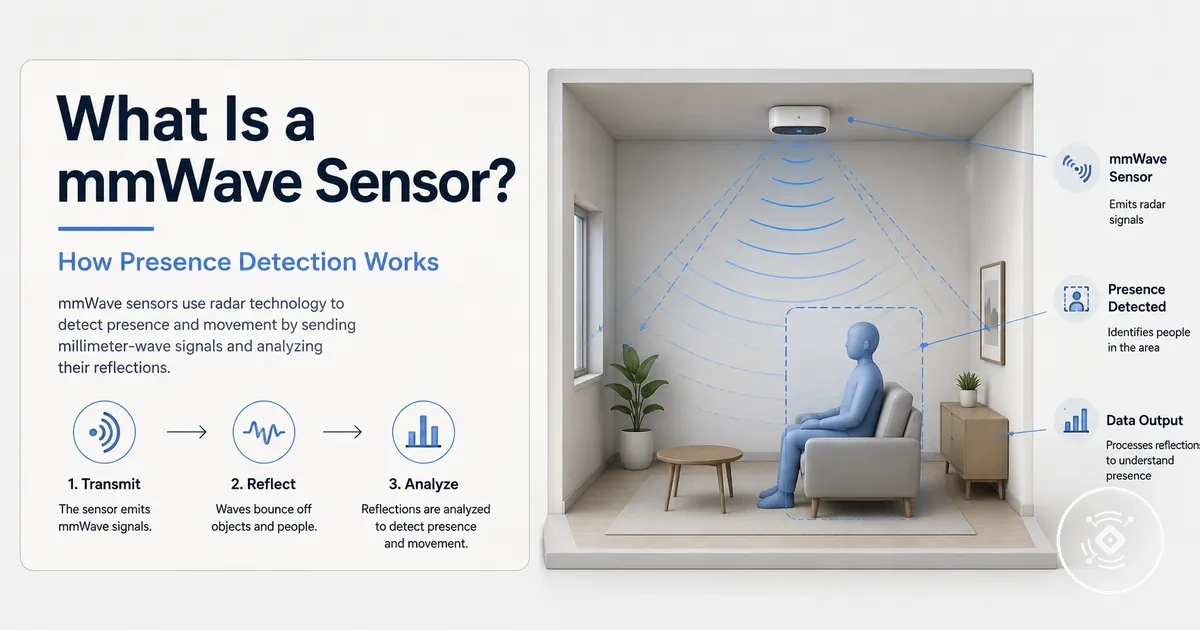
mmWave radar detects human presence by sending an emitted radar signal into an area and interpreting changes in the returned reflected wave. The sensor uses the relationship between the outgoing and returning signal to create an occupancy output based on detected patterns.
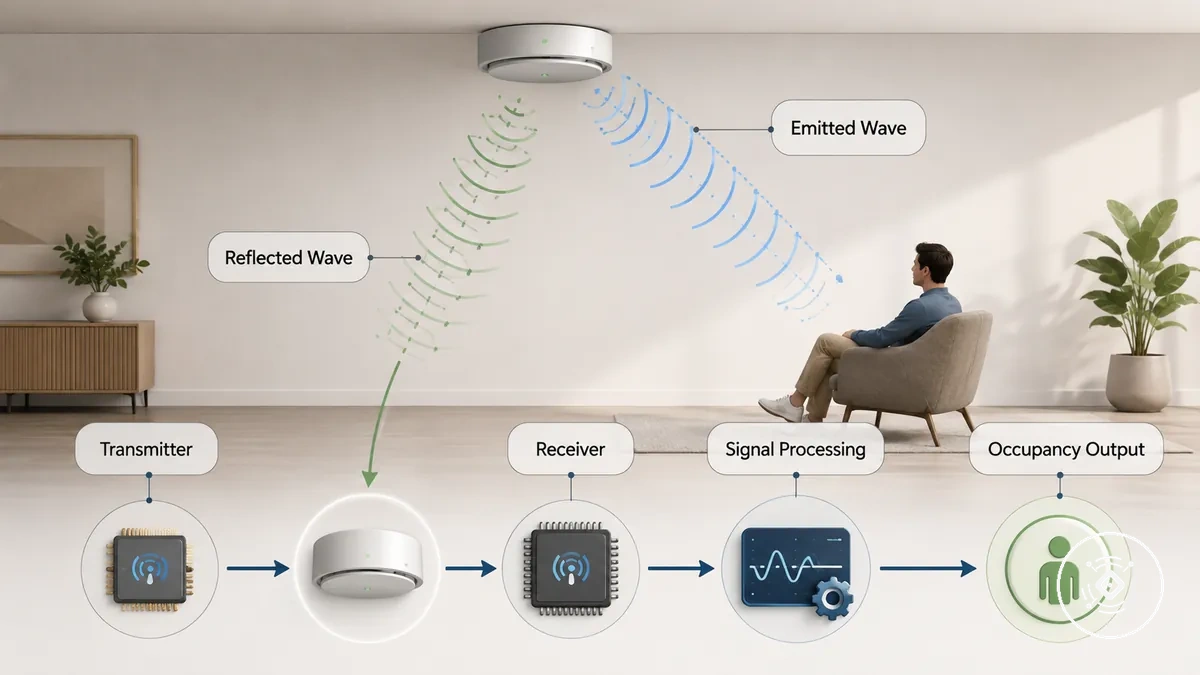
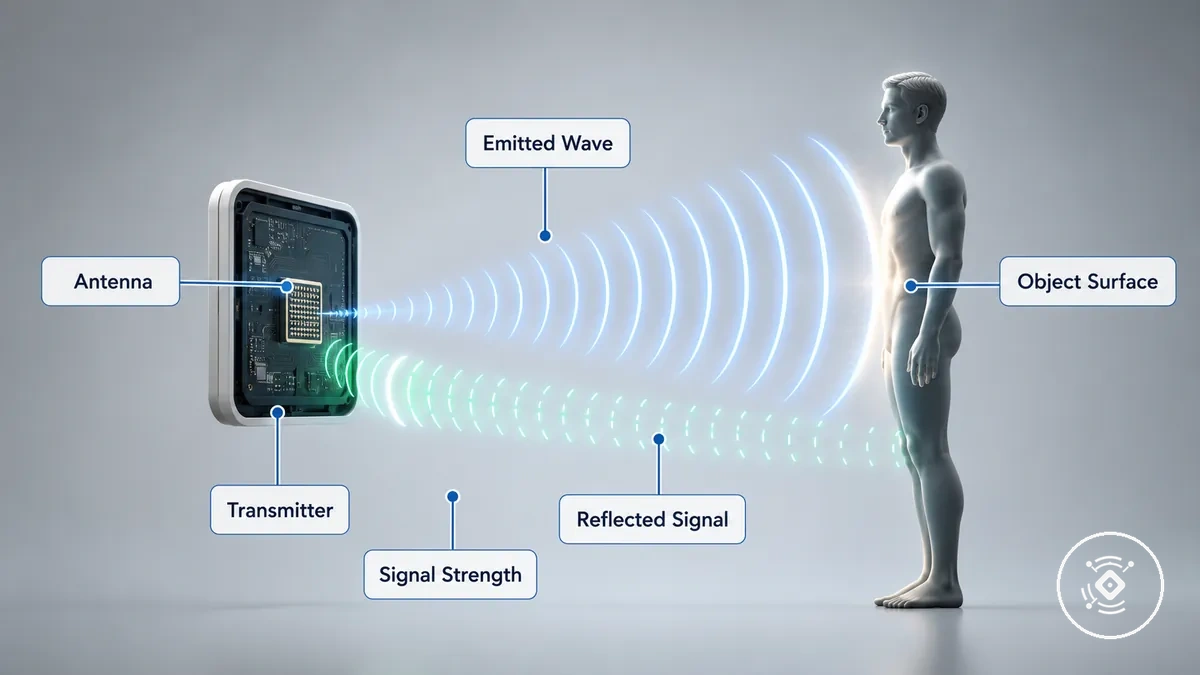
The detection process involves a transmitter sending an emitted wave, a receiver collecting the reflected wave, and signal processing that interprets the returned information. The radar subsystem evaluates movement patterns and signal changes that may relate to human presence. The final occupancy output depends on how the sensor processes these conditions and can vary by sensor design, configuration, and room conditions.
In a room environment, a stationary person sitting at a desk may create small changes in the reflected signal that contribute to a detected movement pattern. The result depends on factors such as placement and surrounding conditions, which can influence how the sensor interprets the radar reflection.
mmWave radar does not rely on visual tracking to determine presence. The detection logic connects emitted signals, reflected waves, receivers, and signal processing to infer occupancy, while the way each sensor converts these inputs into an output can vary.
Emitted Radio Waves and Reflected Signals
mmWave sensors send emitted radio waves into a detection area through a transmitter and antenna, then receive reflected signals from bodies and objects. The outgoing radar wave creates the first part of the sensing path by directing energy toward the surrounding area.
When a wave interacts with an object surface, part of the energy may return toward the sensor as a reflection. The returned signal can vary based on conditions around the detection area, influencing the signal strength and returned energy received by the antenna.
Doppler Shifts and Micro-Movement Detection
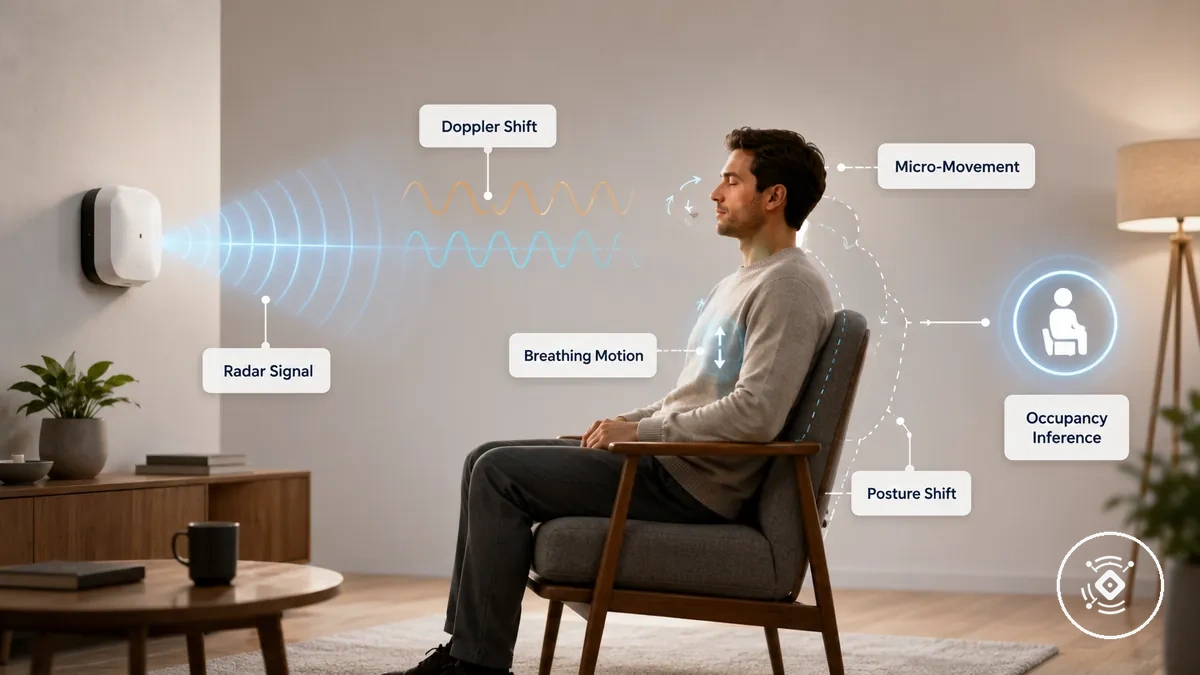
A Doppler shift describes how movement can create frequency change or phase change in a returned radar signal, allowing a mmWave sensor to interpret small movement patterns. These changes can contribute to occupancy inference by showing signal variation associated with micro-movement from a human body.
Micro-movement such as breathing motion, posture shift, or small body movement may create changes that a sensor processes as part of a presence pattern. A stationary occupant can produce signal variations that support interpretation, but detection depends on hardware, firmware, sensitivity settings, and surrounding conditions. The reliability of this process can vary between sensor designs and environments.
- Breathing: Small body movement that may contribute to signal variation.
- Posture shift: A body position change that can alter returned signal patterns.
- Hand movement: Small limb movement that may influence detected signal changes.
- Body sway: Minor movement that can contribute to occupancy inference.
Why mmWave Sensors Can Detect Stationary People
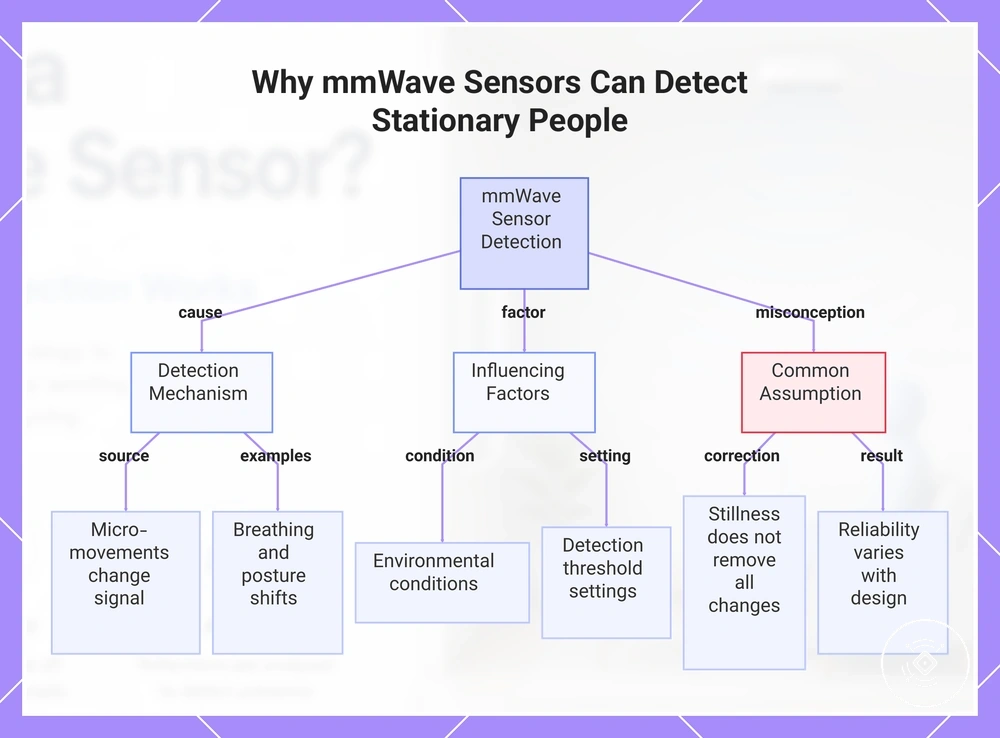
mmWave sensors can often detect stationary people because a still occupant may create small movements that change the reflected signal. Breathing motion, posture changes, and other micro-movement can create signal variation that helps the sensor interpret occupancy even when obvious movement is limited.
A seated person in a room may create changes that contribute to a presence pattern, but reliability depends on surrounding conditions. Distance, shielding, furniture blockage, posture, and detection threshold settings can influence how the sensor interprets returned signals. A very still occupant or a covered person may produce fewer changes for the sensor to process.
- Seated person: A posture shift or small movement may contribute to signal variation.
- Sleeping person: Breathing motion may create detectable changes, but results depend on conditions and sensor settings.
- Blocked person: Furniture or shielding may reduce the signal changes available for interpretation.
- Pet movement: Moving animals may create signals that require careful context when interpreting occupancy.
A common assumption is that a motionless person becomes invisible to a mmWave sensor, but stillness does not remove all possible signal changes. The sensor interprets movement patterns rather than identifying a person, so reliability varies with sensor design, environment, and surrounding conditions.
This chart explains how mmWave sensors detect stationary people through micro-movements, the factors affecting reliability, and a common misconception.
Main Components Inside a mmWave Presence Sensor
A mmWave presence sensor uses multiple internal and interface components that work together to detect, process, and report occupancy information. Each component has a specific role in moving from radar emission to occupancy output, with the radar module, antenna, signal processor, and supporting parts cooperating as one sensing system.
The components of a mmWave presence sensor are best understood through their functions rather than as a feature list. The table below connects each component with the signal or condition it handles and the effect it can have on the occupancy output.
A mmWave presence sensor is not defined by a single component alone. The internal arrangement, communication interface, optional sensors, and integrated designs can vary by sensor model and configuration.
| Component | Function | Signal or condition handled | Effect on occupancy output |
|---|---|---|---|
| Radar module | Handles radar-based sensing activity | Emitted and returned radar signals | Provides sensing information used for occupancy interpretation |
| Antenna | Sends and receives radar signals | Emitted waves and reflected signals | Supports the collection of sensing information |
| Signal processor | Processes received signal information | Signal variation and movement patterns | Helps convert sensor readings into occupancy output |
| Power input | Provides operating power to the sensor | Power supply conditions | Allows internal components to function |
| Communication interface | Transfers sensor information to connected systems | Output communication signals | Allows occupancy information to be reported |
| Enclosure | Houses and protects internal components | Physical structure and surrounding conditions | Supports the overall sensor assembly |
| Optional sensors | Provide additional sensing inputs when included | Additional environmental conditions | May influence how available information is interpreted |
Radar Module, Antenna, and Signal Processor
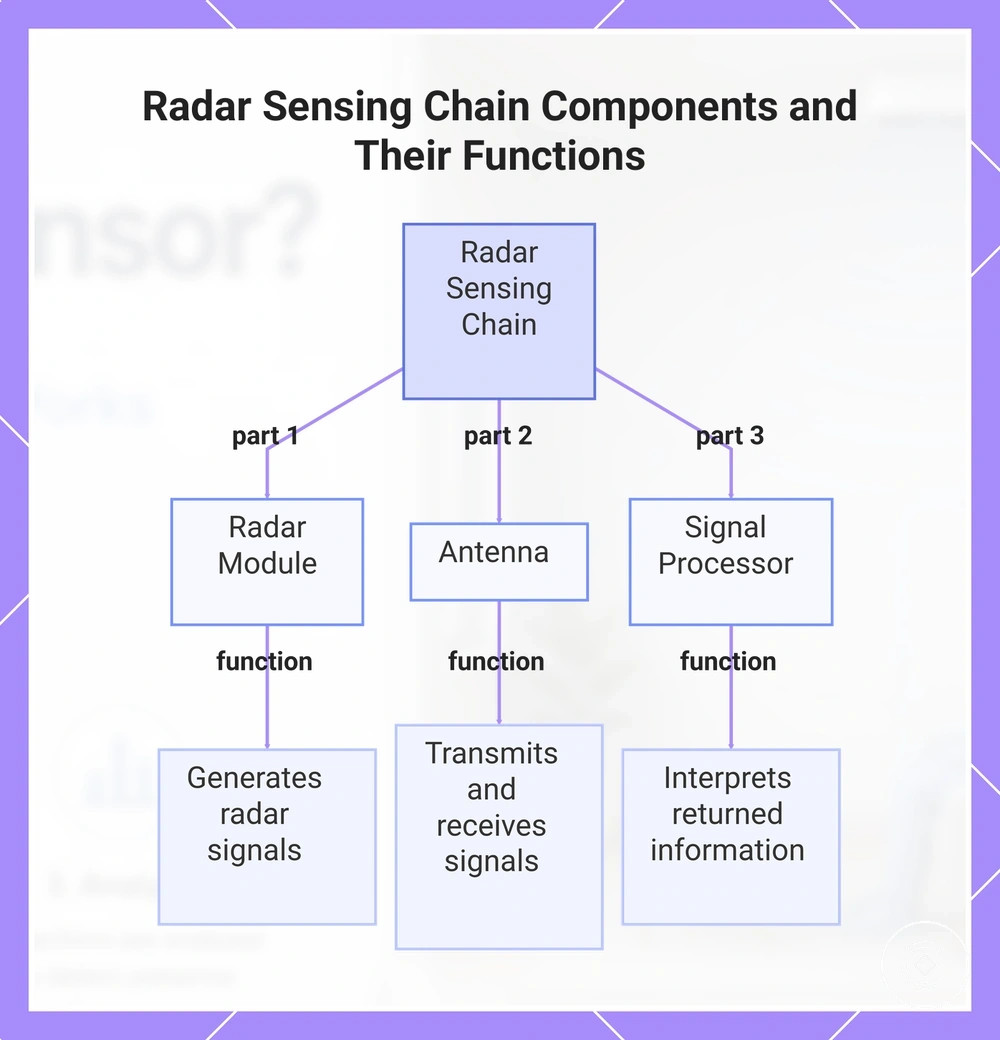
The radar module, antenna, and signal processor form the sensing chain that generates radar signals, receives reflections, and interprets the returned information. The radar module produces the generated signal, the antenna manages signal transmission and reception, and the signal processor supports interpretation of the received signal conditions.
The radar module, antenna, and signal processor each contribute a different function within the sensing process. The radar module creates the sensing activity, the antenna supports the movement of signals and reflections, and the signal processor evaluates the received information to support occupancy output. The physical arrangement can vary between integrated modules and separate board designs depending on the sensor model and configuration.
This chart shows the three main components of a radar sensing chain and the specific function each performs in generating, transmitting, and interpreting radar signals.
Power, Control, and Smart-Home Interface Parts
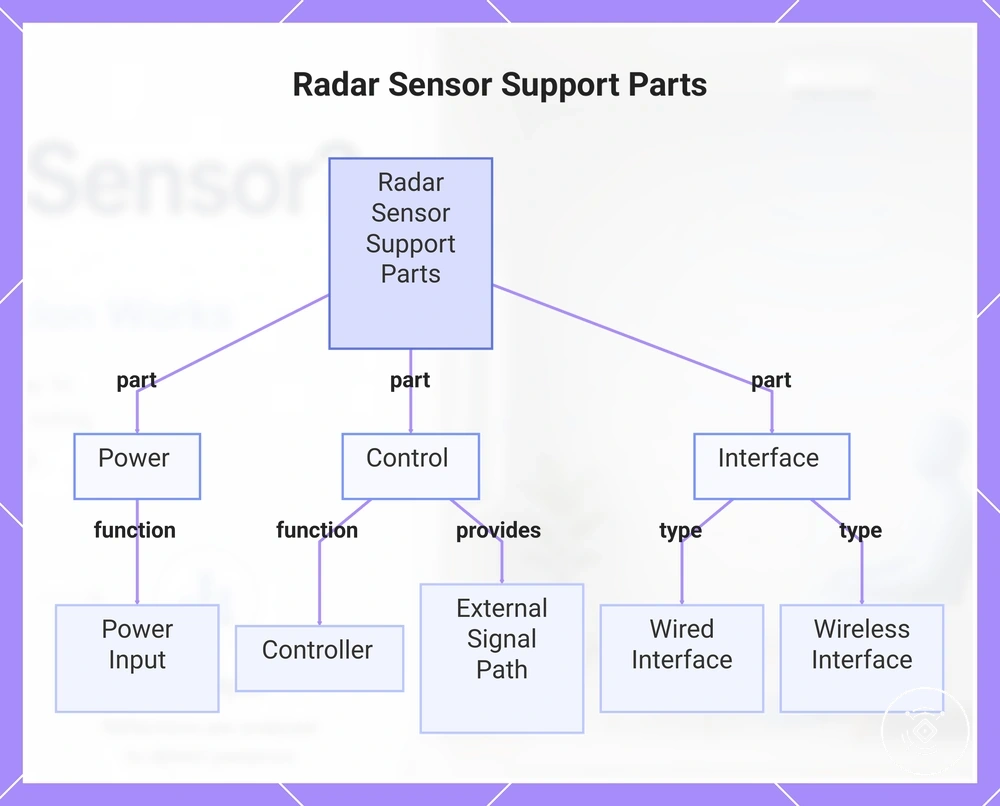
The power input, controller, relay, and communication interface parts support the radar subsystem by providing power, managing signals, and exposing occupancy status. These support parts are different from detection parts because they help operate, control, and report sensor information rather than generate radar-based presence signals.
The controller can manage output status, while a relay or output pin may provide an external signal path when included. Wired interface, wireless interface, and firmware settings can vary by model, so available functions and automation connections are specification-dependent.
- Power input: Provides the energy required for sensor operation and internal component activity.
- Controller: Manages internal control functions and helps handle occupancy output information.
- Relay: May provide a switching function for reporting sensor states when included in the design.
- Output pin: Can expose an output signal for connected systems depending on the sensor design.
- Wired interface: Provides a physical communication path when supported by the model.
- Wireless interface: Allows communication through supported wireless methods when available.
- Firmware settings: May influence how the sensor processes and reports information based on the device configuration.
This chart shows the main support parts of a radar sensor: power input, control components, and communication interfaces, along with their functions.
What mmWave Presence Sensors Can and Cannot Detect
mmWave presence sensors can detect signal changes associated with human presence and movement patterns, but they cannot determine every detail about a person or environment. Detection depends on signal change, material conditions, and sensor configuration, which creates realistic boundaries around what the sensor can infer.
A mmWave presence sensor interprets returned signals rather than understanding identity or intent. It can detect conditions linked to moving people, stationary people with micro-movements, and other signal variations, while the exact result depends on the available signal and surrounding conditions.
| Usually detectable or inferable | Not reliably detectable or outside scope |
|---|---|
| Moving people that create relevant signal changes | Identity of a person or their intent |
| Stationary people with micro-movements such as posture changes or breathing motion | Guaranteed detection of every still occupant in every environment |
| Moving objects or pets that create detectable signal variation | Reliable understanding of what an object or movement source represents |
| Signal changes affected by walls or curtains depending on material conditions and configuration | Universal detection through all walls or materials |
| Occupancy-related changes within the sensor’s configured environment | Personal identity recognition or behavioural intent |
| Potential false occupancy signals caused by environmental movement | Guaranteed interpretation of every detected signal change |
Common sources of confusion include walls, curtains, fans, pets, and moving objects. These conditions can influence signal variation or create false occupancy indications depending on material conditions, sensor configuration, and the surrounding environment.
Understanding the detection range and sensitivity helps explain why settings, distance, and conditions affect the detection boundary. The sensor’s outcome can vary by model design, configuration, and the type of signal change available for interpretation.
How mmWave Presence Sensing Differs from Basic Motion Detection
Presence sensing and motion detection differ in the type of signal information they use and the occupancy outcomes they can infer. Basic motion detection generally responds to movement events, while mmWave presence sensing can interpret radar reflection and micro-movement patterns to provide a different view of occupancy conditions.
Motion detection typically focuses on noticeable movement or heat-change logic, while presence sensing focuses on signal changes that may indicate an ongoing occupied state. PIR uses heat-change logic to identify movement-related conditions, while mmWave sensing uses radar reflection patterns that can include smaller movements from a still occupant. This difference can influence how each approach behaves when movement is limited.
| Dimension | Basic motion detection | mmWave presence sensing | Practical meaning |
|---|---|---|---|
| Signal type | Often responds to movement or heat-change conditions | Uses mmWave radar reflection and signal variation | The sensing method affects the type of occupancy information available |
| Still occupant | May require noticeable movement to create a trigger | Can interpret smaller movement patterns such as micro-movement | Still occupants may create different sensing conditions |
| PIR behaviour | Uses PIR heat-change logic for movement-related detection | Uses radar reflection patterns from the sensing environment | The two approaches rely on different signal sources |
| False triggers | Can vary with environmental conditions and movement sources | Can also vary depending on settings and room context | Outcomes depend on the sensor and surrounding conditions |
| Automation behavior | Often follows motion-triggered events | May support occupancy-based automation responses | Automation results depend on configuration and use conditions |
A common assumption is that motion detection and presence sensing provide the same information, but they interpret different signals. A more detailed explanation of presence detection compared with motion detection covers the broader trade-offs, while this section focuses on the basic difference between the two approaches.
Where mmWave Presence Sensors Are Used
A person working in an office, resting in a bedroom, or spending time in a bathroom can create different occupancy needs depending on room activity and automation goals. mmWave presence sensors are used in spaces where understanding room occupancy can support automation behavior, especially when movement is limited.
Common use contexts depend on placement, room behavior, and how an automation system is intended to respond. These sensors can be relevant in low-motion spaces where stationary detection provides additional occupancy information beyond short movement events.
- Smart lighting: Can support lighting control when room occupancy changes and low-motion activity affect automation decisions.
- HVAC control: Can provide occupancy context where climate-related automation depends on room presence and usage patterns.
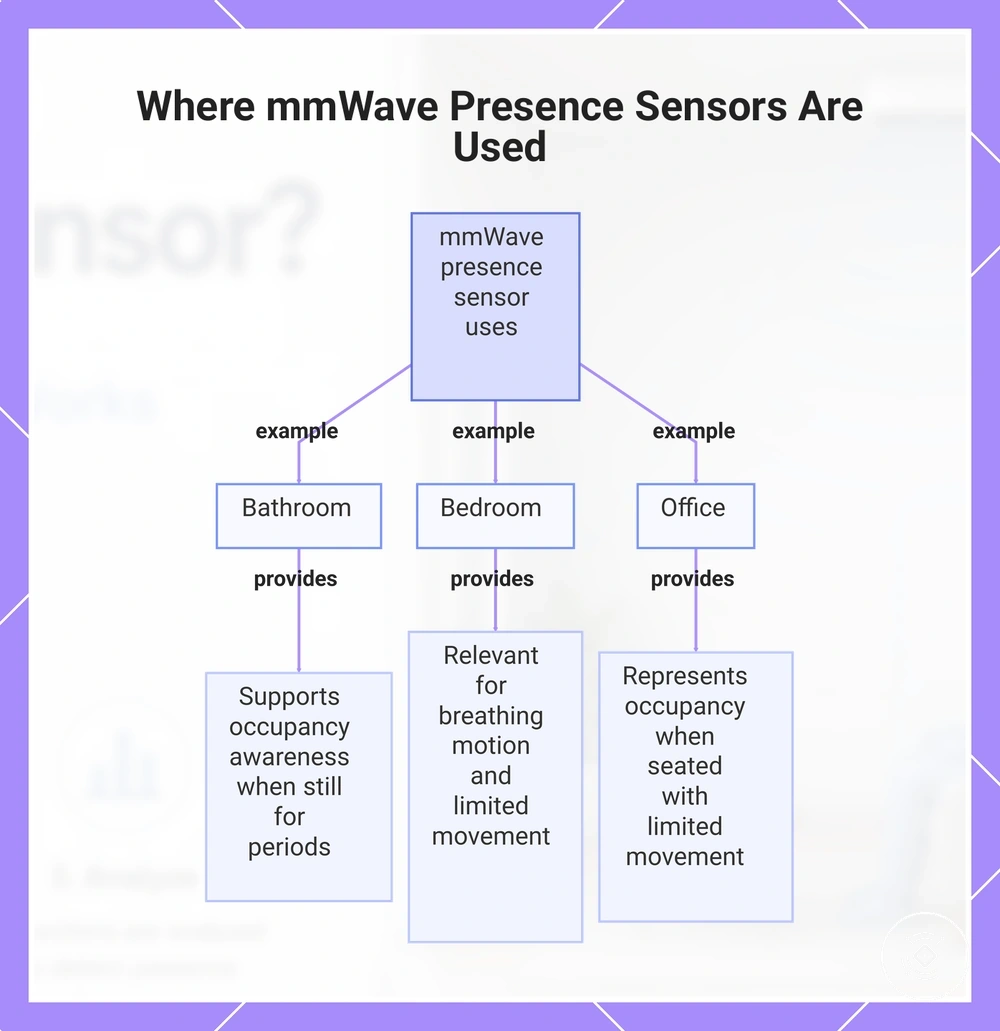
- Bathroom: Can support occupancy awareness in a room where people may remain still for periods of time.
- Bedroom: Can be relevant in a low-motion space where breathing motion or limited movement may contribute to occupancy interpretation.
- Office: Can help represent room occupancy when a person remains seated with limited movement.
Usefulness depends on how the room behaves and how automation is intended to respond. A low-motion space may benefit from presence sensing when placement, activity patterns, and sensitivity conditions align with the intended use, but the fit remains conditional.
This chart shows the primary use contexts of mmWave presence sensors in low-motion spaces: bathroom, bedroom, and office.
Common Questions About mmWave Presence Sensor Basics
What is a mmWave presence sensor?
A mmWave presence sensor is a sensor that uses millimeter-wave radar signals to interpret occupancy conditions. It detects signal changes associated with human presence rather than identifying a specific person. The exact response can vary depending on sensor design and surrounding conditions.
Can a mmWave presence sensor detect stationary people?
Yes, a mmWave presence sensor can often detect stationary people when small movements create detectable signal changes. Breathing motion, posture shifts, and other micro-movements may contribute to occupancy interpretation. Results depend on the sensor configuration, environment, and detection conditions.
Can a mmWave presence sensor detect through walls?
A mmWave presence sensor cannot be assumed to detect through every wall or material. Walls and other materials can affect how signals behave, so detection limits depend on the specific environment and sensor conditions.
Can pets affect mmWave presence detection?
Yes, pets can affect mmWave presence detection because moving animals may create signal changes. Whether this influences occupancy interpretation depends on movement patterns, room conditions, and sensor configuration.
Does a mmWave presence sensor replace motion detection?
No, a mmWave presence sensor and motion detection are different sensing approaches. Motion detection typically focuses on movement events, while presence sensing can interpret occupancy-related signal changes. The suitable approach depends on the intended use and environment.
Does a mmWave presence sensor identify people?
No, a mmWave presence sensor does not identify a person’s identity or intent. It interprets occupancy-related signals rather than personal information.
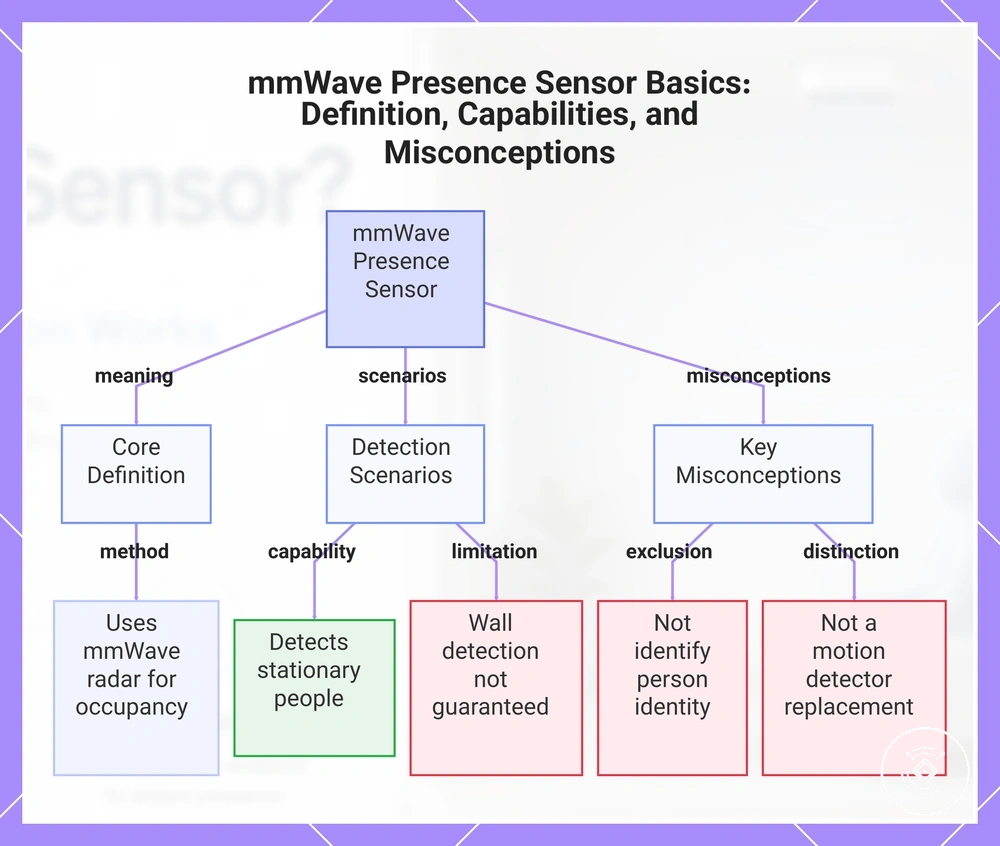
This chart explains the core definition, detection capabilities, and key misconceptions about mmWave presence sensors.